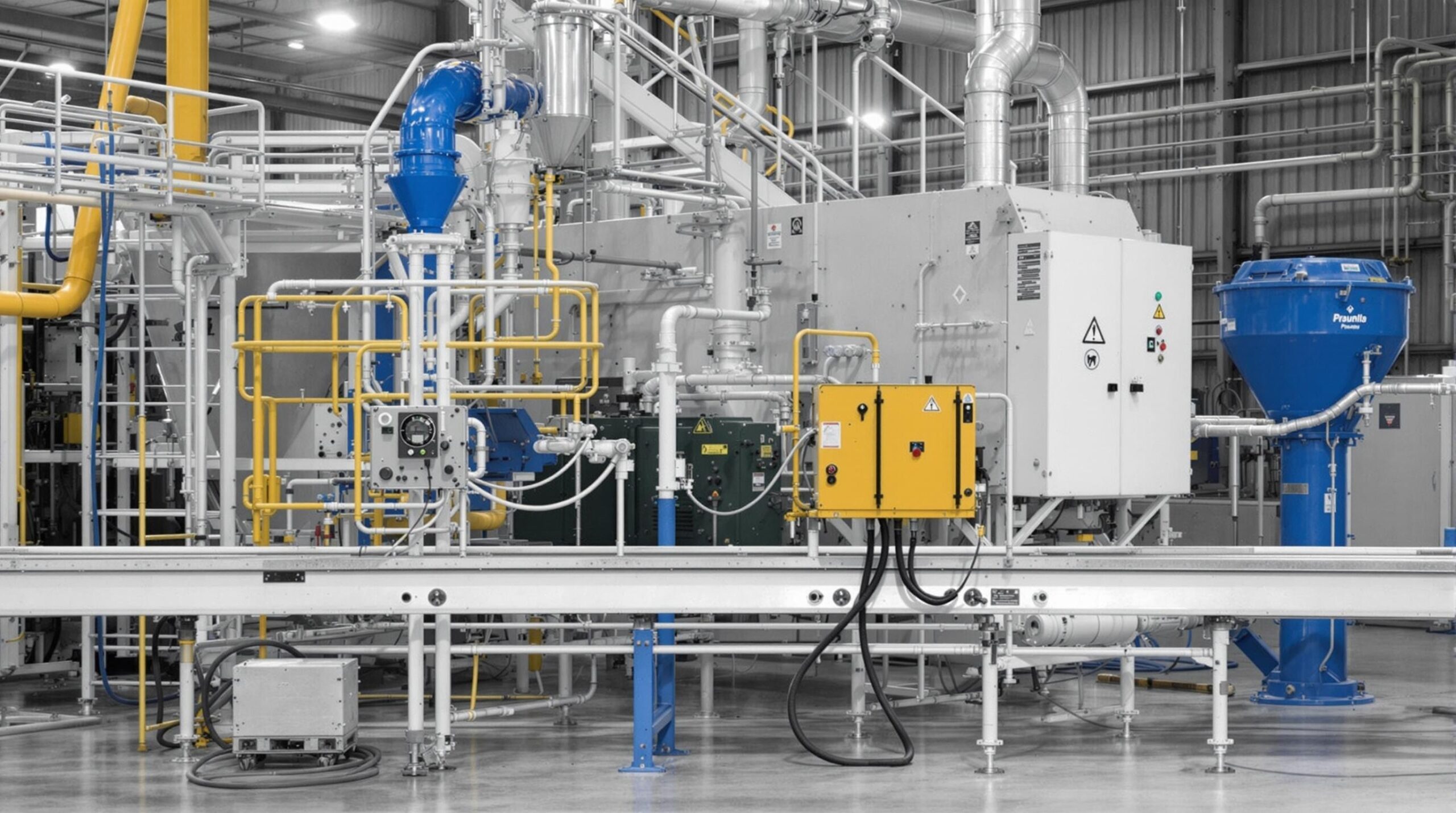
Production efficiency of equipment is a crucial metric for businesses that want to optimize their operations and maximize their output. By understanding how to calculate production efficiency accurately, you can identify bottlenecks, reduce downtime, and implement improvements that lead to significant cost savings and productivity gains.
Key takeaways
- Overall Equipment Effectiveness (OEE) is the gold standard formula for measuring equipment production efficiency
- Production efficiency calculations require data on availability, performance, and quality rates
- Regular monitoring helps identify improvement opportunities and prevent efficiency losses
- Both quantitative measurements and qualitative observations are essential for comprehensive efficiency analysis
- Advanced technologies like IoT sensors and analytics software can automate efficiency calculations
What is Production Efficiency?
Production efficiency refers to the effectiveness and productivity of manufacturing equipment in converting inputs into outputs. It measures how well a machine, production line, or facility uses resources (time, materials, energy) to produce goods that meet quality standards. High production efficiency indicates that equipment is operating close to its theoretical maximum capacity while minimizing waste and downtime.
For manufacturing businesses, maintaining optimal production efficiency is not just about keeping machines running—it's about maximizing value creation from existing assets. Efficient equipment produces more goods with fewer resources, leading to higher profitability and competitiveness in the market.
Why Measuring Equipment Efficiency Matters
Calculating and tracking equipment efficiency provides wawasan berharga into your production processes. Without proper measurement, it's impossible to know if your equipment is performing at optimal levels or if there's room for improvement.
Regular efficiency monitoring helps you:
- Identify underperforming equipment that may need maintenance or replacement
- Detect production bottlenecks and inefficiencies
- Make data-driven decisions about process improvements
- Set realistic production targets and schedules
- Justify investments in new equipment or technologies
- Compare performance across different machines, shifts, or facilities
When efficiency metrics drop, it serves as an early warning system for potential problems. This allows maintenance teams to address issues before they lead to catastrophic failures or extended production stoppages.
The OEE Formula: The Gold Standard for Efficiency Calculation

Overall Equipment Effectiveness (OEE) is the most comprehensive method for calculating production efficiency. This metric considers three critical factors that affect equipment performance:
The formula for OEE is:
OEE = Availability × Performance × Quality
Each component measures a different aspect of efficiency:
- Availability: The percentage of scheduled time that the equipment is available to operate
- Performance: The speed at which the equipment runs compared to its designed speed
- Quality: The percentage of good units produced compared to the total units started
The result is expressed as a percentage, with 100% representing perfect production (running at maximum speed, with no stops, and producing only good parts). Most manufacturing operations consider an OEE of 85% or higher to be world-class performance.
Calculating Availability Rate
The availability rate measures how much of the planned production time your equipment is actually running. It accounts for downtime losses due to equipment failures, setup and adjustments, and other stops.
To calculate availability rate:
Availability = Run Time ÷ Planned Production Time
For example, if your equipment was scheduled to run for 8 hours (480 minutes) but had 60 minutes of downtime due to breakdowns and adjustments, your calculation would be:
Availability = (480 - 60) ÷ 480 = 0.875 or 87.5%
Tracking availability helps identify the primary causes of equipment downtime. Common availability losses include:
- Equipment failures and breakdowns
- Setup and adjustment time
- Tooling changes
- Material shortages
- Operator unavailability
Calculating Performance Rate
The performance rate measures how quickly your equipment operates compared to its designed speed capability. It accounts for speed losses due to reduced operating speeds and small stops or idle time.
To calculate performance rate:
Performance = (Total Pieces ÷ Run Time) ÷ Ideal Run Rate
Alternatively, you can use:
Performance = (Actual Output ÷ Possible Output at Standard Speed) × 100%
For example, if your equipment produced 400 units during 420 minutes of run time, and the ideal rate is 1.2 units per minute:
Performance = (400 ÷ 420) ÷ 1.2 = 0.79 or 79%
Common causes of performance losses include:
- Operating below the equipment's designed speed
- Minor stops and idling (less than 5 minutes)
- Operator inefficiency
- Suboptimal materials or inputs
- Irregular machine feeding
Calculating Quality Rate
The quality rate measures how many good units your equipment produces compared to the total units started. It accounts for quality losses due to defects and rework.
To calculate quality rate:
Quality = Good Units ÷ Total Units Produced
For example, if your equipment produced 400 total units but 20 were defective:
Quality = (400 - 20) ÷ 400 = 0.95 or 95%
Quality losses can occur due to:
- Production defects (units that don't meet specifications)
- Scrap materials
- Rework requirements
- Units damaged during startup
- Yield loss during the production process
Putting It All Together: OEE Calculation Example
Let's combine all three components to calculate OEE for a typical production scenario:
Given information:
- Planned production time: 8 hours (480 minutes)
- Downtime: 60 minutes
- Total units produced: 400
- Ideal run rate: 1.2 units per minute
- Defective units: 20
Step 1: Calculate Availability Rate
Availability = (480 - 60) ÷ 480 = 0.875 or 87.5%
Step 2: Calculate Performance Rate
Performance = (400 ÷ 420) ÷ 1.2 = 0.79 or 79%
Step 3: Calculate Quality Rate
Quality = (400 - 20) ÷ 400 = 0.95 or 95%
Step 4: Calculate OEE
OEE = 0.875 × 0.79 × 0.95 = 0.657 or 65.7%
This OEE of 65.7% suggests there's significant room for improvement, as world-class OEE is generally considered to be 85% or higher.
Alternative Efficiency Metrics
While OEE is the most comprehensive efficiency metric, other specialized calculations can provide additional insights:
TEEP (Total Effective Equipment Performance)
TEEP measures how effectively you're using your equipment relative to all available time (24/7), not just planned production time. It's calculated as:
TEEP = OEE × Loading
Where Loading = Planned Production Time ÷ All Available Time (24/7)
TEEP helps you understand if you should schedule more production time to meet demand rather than investing in new equipment.
Capacity Utilization
This metric focuses specifically on how much of your equipment's designed capacity you're utilizing:
Capacity Utilization = Actual Output ÷ Maximum Possible Output × 100%
Capacity utilization is particularly useful for strategic planning and determining when to expand production capabilities.
Throughput Rate
Throughput measures the average output over a specific period:
Throughput Rate = Total Output ÷ Time Period
This straightforward metric helps track productivity trends and can be used to identify when equipment performance is declining.
Data Collection for Efficiency Calculations

Accurate efficiency calculations depend on reliable data. Here are the key data points you need to collect:
Time Data
- Planned production time
- Actual running time
- Downtime (categorized by cause)
- Setup and changeover times
- Maintenance periods
Performance Data
- Actual production count
- Standard production rate
- Cycle times
- Speed losses
- Minor stops
Quality Data
- Total units produced
- Good units produced
- Defect rates
- Rework required
- Scrap generated
The most effective approach combines automated data collection (through SCADA systems, IoT sensors, or machine controllers) with manual observations and quality checks.
Tools and Technologies for Efficiency Monitoring
Modern manufacturing facilities use various technological solutions to calculate and monitor production efficiency:
MES (Manufacturing Execution Systems)
These comprehensive systems automatically collect production data and calculate efficiency metrics in real-time. They often provide dashboards and reports that help managers identify efficiency trends and problems quickly.
IoT Sensors and Devices
Internet of Things sensors attached to equipment can continuously monitor operating parameters such as speed, temperature, vibration, and production counts. This data feeds directly into efficiency calculation systems.
CMMS (Computerized Maintenance Management Systems)
These systems track equipment maintenance history and downtime, providing critical data for availability calculations and helping prevent efficiency losses due to equipment failures.
OEE Software
Specialized software solutions focus specifically on OEE calculations and analysis. They typically offer visualization tools, historical trending, and alerts when efficiency falls below target levels.
ERP (Enterprise Resource Planning) Systems
Many ERP systems include production modules that can track efficiency metrics and integrate them with broader business data like costs and resource allocation.
Improving Production Efficiency

Once you've calculated your equipment's efficiency, the next step is to implement improvements. Here are strategies targeting each component of OEE:
Improving Availability
- Implement preventive maintenance programs to reduce breakdowns
- Optimize setup and changeover procedures (SMED techniques)
- Train operators on quick troubleshooting for common issues
- Ensure adequate spare parts inventory for critical components
- Use predictive maintenance technologies to anticipate failures
Improving Performance
- Identify and address speed loss causes
- Optimize machine settings for different products
- Train operators on optimal machine handling
- Maintain equipment to manufacturer specifications
- Eliminate minor stops through process improvements
Improving Quality
- Implement in-line quality monitoring systems
- Train operators on quality standards and inspection
- Address root causes of defects through problem-solving methodologies
- Optimize process parameters to reduce variability
- Implement mistake-proofing (poka-yoke) systems
The most effective approach is to tackle the largest efficiency losses first, which often delivers the greatest return on investment.
Setting Realistic Efficiency Targets
While 100% efficiency might seem like the ideal goal, it's rarely achievable in practical operations. Instead, set challenging but attainable targets based on:
- Industry benchmarks for similar equipment and processes
- Historical performance of your own equipment
- Equipment manufacturer specifications
- Improvement trends and rates of progress
- Available resources for improvement initiatives
A common approach is to set tiered targets that progressively increase as improvements are implemented. For example, if your current OEE is 65%, you might set targets of 70%, then 75%, then 80% over defined time periods.
Common Pitfalls in Efficiency Calculations
Watch out for these common mistakes when calculating and interpreting production efficiency:
Inconsistent Definitions
Using different definitions for planned production time, downtime, or defects across different calculations or time periods makes comparisons meaningless.
Ignoring Context
Efficiency numbers without context can be misleading. For example, efficiency might naturally be lower during product changeovers or new product introductions.
Focusing Only on Equipment Speed
Running equipment at maximum speed often leads to more quality issues or breakdowns. The goal is optimal efficiency, not maximum speed.
Not Accounting for All Losses
Some losses, like minor stops or small quality defects, might seem insignificant but can add up to major efficiency drains over time.
Over-reliance on Averages
Using average efficiency figures can hide significant variations. A machine might have excellent efficiency most of the time but catastrophic failures occasionally.
Continuous Improvement Approach to Efficiency
Calculating efficiency isn't a one-time activity but part of a perbaikan berkelanjutan cycle:
1. Measure Current Efficiency
Establish baseline metrics using the OEE formula and other relevant calculations.
2. Analyze Losses
Uraikan kerugian efisiensi berdasarkan kategori untuk mengidentifikasi peluang terbesar.
3. Prioritize Improvements
Fokuslah untuk mengatasi kerugian efisiensi terbesar atau yang paling mudah diperbaiki terlebih dahulu.
4. Implement Solutions
Lakukan perubahan pada peralatan, proses, atau pelatihan untuk mengatasi masalah yang teridentifikasi.
5. Re-measure and Verify
Hitung kembali efisiensi untuk mengkonfirmasi peningkatan dan mengukur manfaatnya.
6. Standardize and Document
Dokumentasikan perbaikan yang berhasil dan standarisasi metode baru.
7. Repeat the Cycle
Lanjutkan ke area prioritas peningkatan berikutnya.
Pendekatan metodis ini memastikan efisiensi. terus menerus meningkatkan Seiring waktu, bukan meningkat sementara lalu kemudian turun kembali.
Case Study Examples
Berikut beberapa contoh bagaimana perhitungan dan peningkatan efisiensi produksi memberikan manfaat bagi operasi manufaktur nyata:
Food Processing Factory
Sebuah perusahaan pengolahan makanan menghitung bahwa lini pengemasannya hanya beroperasi pada 62% OEE. Analisis menunjukkan bahwa sebagian besar kerugian berasal dari sering berhenti di tempat-tempat kecil Hal ini disebabkan oleh ketidaksesuaian bahan kemasan. Dengan mendesain ulang sistem pengumpanan dan menerapkan perawatan pencegahan, mereka meningkatkan OEE menjadi 78% dalam waktu tiga bulan, meningkatkan output lebih dari 25% tanpa menambah peralatan.
Automotive Parts Manufacturer
Sebuah perusahaan suku cadang otomotif menemukan bahwa pusat permesinan mereka memiliki tingkat ketersediaan (92%) dan kualitas (98%) yang baik, tetapi kinerja yang buruk (71%). Investigasi mengungkapkan bahwa operatornya berlari dengan sengaja Peralatan tersebut beroperasi lebih lambat dari kecepatan yang dirancang karena kekhawatiran tentang keausan alat. Dengan mengoptimalkan parameter pemotongan dan menerapkan sistem manajemen alat yang lebih efektif, mereka meningkatkan kinerja menjadi 86% sambil mempertahankan umur pakai alat.
Electronics Assembly
Sebuah perusahaan manufaktur elektronik mengalami kesulitan dengan tingkat kerusakan yang tinggi pada jalur perakitan papan sirkuit, dengan tingkat kualitas hanya 88%. Dengan menerapkan inspeksi optik otomatis Dengan mengatasi akar penyebab cacat sejak awal proses, mereka meningkatkan tingkat kualitas menjadi 97%, yang memberikan kontribusi signifikan terhadap peningkatan OEE keseluruhan dari 69% menjadi 81%.
Efficiency Calculation in Industry 4.0
Revolusi Industri 4.0 mengubah cara kita menghitung dan meningkatkan efisiensi produksi melalui teknologi canggih:
Pemantauan Waktu Nyata
Sensor pintar dan mesin yang terhubung memberikan umpan balik instan tentang metrik efisiensi, memungkinkan penyesuaian segera ketika kinerja menurun.
Predictive Analytics
Algoritma pembelajaran mesin dapat memprediksi kapan efisiensi kemungkinan akan menurun berdasarkan pola dalam data historis, sehingga memungkinkan intervensi proaktif.
Digital Twins
Replika virtual dari peralatan fisik memungkinkan simulasi dan optimalisasi efisiensi tanpa mengganggu produksi aktual.
Augmented Reality
Alat AR dapat memandu operator melalui prosedur optimal dan membantu teknisi perawatan dengan cepat mengatasi masalah yang memengaruhi efisiensi.
Autonomous Optimization
Sistem canggih dapat secara otomatis menyesuaikan parameter mesin untuk menjaga efisiensi puncak seiring perubahan kondisi.
Teknologi-teknologi ini tidak hanya membuat perhitungan efisiensi lebih akurat dan tepat waktu, tetapi juga memungkinkan strategi peningkatan yang lebih canggih.
Tanya Jawab Umum
What is a good OEE percentage?
Secara umum, OEE sebesar 85% atau lebih tinggi dianggap berkelas dunia. Sebagian besar operasi manufaktur beroperasi dalam kisaran 60-75%. Namun, apa yang dianggap "baik" bervariasi tergantung industri dan jenis peralatan. Untuk peralatan atau proses baru, bahkan 50% mungkin dapat diterima pada awalnya, dengan target peningkatan yang ditetapkan dari waktu ke waktu.
How often should I calculate production efficiency?
Untuk sebagian besar operasi, perhitungan harian memberikan keseimbangan yang baik antara memiliki informasi tepat waktu dan mengelola upaya pengumpulan data. Namun, dengan sistem otomatis, perhitungan waktu nyata atau per jam semakin umum. Minimal, perhitungan mingguan direkomendasikan untuk mengidentifikasi tren.
Which is more important: availability, performance, or quality?
Ketiga komponen tersebut merupakan bagian penting dari efisiensi keseluruhan, tetapi kepentingan relatifnya dapat bervariasi tergantung pada operasinya. Dalam manufaktur volume tinggi, kinerja mungkin yang paling penting. Untuk peralatan presisi, kualitas mungkin menjadi prioritas. Untuk peralatan dengan biaya pengaturan yang tinggi, ketersediaan bisa menjadi fokus utama.
Bisakah saya menghitung OEE jika saya tidak mengetahui tingkat pengoperasian ideal peralatan saya?
Jika spesifikasi pabrikan tidak tersedia, Anda dapat menentukan tingkat pengoperasian ideal dengan menganalisis data historis untuk mengidentifikasi kinerja berkelanjutan terbaik yang telah dicapai peralatan Anda. Ini menjadi dasar perhitungan kinerja Anda.
Should maintenance time be counted as downtime in efficiency calculations?
Pemeliharaan terencana biasanya dikecualikan dari perhitungan waktu henti. Komponen ketersediaan OEE hanya mempertimbangkan waktu henti yang tidak terencana terhadap waktu produksi yang direncanakan. Namun, jika Anda menghitung kinerja efektivitas peralatan total (TEEP), semua waktu non-produktif, termasuk pemeliharaan terencana, diperhitungkan dalam persamaan tersebut.