
How to Choose a PU Sandwich Panel Production Line: 12-Point Buyer's Evaluation Framework
Choosing a PU sandwich panel production line is not one decision — it is twelve. Most first-time cold-room panel factories buy on line speed and CAPEX, then spend the next three years fighting scope gaps, undersized moulds, mismatched foaming systems and stranded spare-parts inventory that were all preventable at the RFQ stage. This buyer's guide is the 12-point evaluation framework we run every serious PU sandwich panel line inquiry through — what scope must be quoted, what press specs actually matter, what foaming machine pressure fits your foam density, what controls belong on the line, and the five commercial terms that decide whether the line ships on time or ships late by six months.

The 12 evaluation axes for a PU sandwich panel production line, in the order they decide the project: (1) scope of supply — coil to cut, or press only. (2) press length and cure economics — 25 m minimum for continuous, mould length for discontinuous. (3) panel width, thickness and edge-profile range. (4) foaming machine pressure and shot-weight capacity matched to your foam density. (5) blowing-agent chemistry — cyclopentane, HFO, HFC-245fa. (6) control system and PLC brand — Siemens, Allen-Bradley, Mitsubishi. (7) skin material compatibility — PPGI coil, stainless, GRP, aluminium. (8) certification and fire class support — EN 14509, FM 4880, ASTM E84. (9) installation, FAT and commissioning terms. (10) spare-parts stocking and 7-year availability. (11) engineering references in your destination market. (12) payment terms and lead-time guarantees. Below 40/60 total score is a high-risk supplier. Most painful misses we see: skipping #4 (foaming machine sizing) and #10 (spare parts) — both invisible at PO, expensive at year 3.
A PU sandwich panel production line is not one purchase — it is twelve. The buyers we see who get their line on time, on budget and hitting nameplate throughput share one habit: they run every quote through the same evaluation checklist and score suppliers axis by axis. The buyers who miss ship dates and spend the second year re-tooling almost always bought on two numbers — line speed and CAPEX — and let the other ten axes get filled in by whichever spec the supplier volunteered. This is the 12-point evaluation framework we hand to every serious cold-room panel manufacturer at the RFQ stage. It is deliberately ordered by the sequence the decisions actually get made: scope first, engineering next, commercial last. Score every quote 1 to 5 on each axis; below 40 out of 60 total is a supplier that will hurt you.
Speed-Read — The 12 Axes and What Each One Really Decides
| # | Axis | What it really decides | Failure cost if you skip it |
|---|---|---|---|
| 1 | Scope of supply | What the supplier is responsible for delivering | USD 80K – 200K in "not in scope" surprises |
| 2 | Press length and cure economics | Line throughput at your foam thickness | 40% throughput below nameplate |
| 3 | Panel dimensions and edge profile | Which of your orders the line can actually make | Lost orders you cannot bid |
| 4 | Foaming machine pressure and shot weight | Foam density uniformity, void rate | 10 – 15% panel reject rate |
| 5 | Blowing agent chemistry compatibility | What foam you can pour without retrofit | Ex-rated equipment surprises |
| 6 | Control system and PLC brand | Serviceability and local integrator support | Multi-week downtime for spare boards |
| 7 | Skin material compatibility | The market segments the line can serve | Cannot bid GRP or plywood-faced work |
| 8 | Certification and fire class | Which markets the panels can be sold into | Whole market segments closed |
| 9 | Installation, FAT and commissioning | How the line reaches nameplate | 6 – 9 month ramp instead of 6 – 12 weeks |
| 10 | Spare-parts stocking and availability | Downtime cost at year 2 – 7 | USD 5K – 40K per unplanned outage |
| 11 | References in your destination market | Whether the supplier has actually done this before | You become the test factory |
| 12 | Payment terms and lead time guarantee | On-time delivery risk | 3 – 6 month schedule slip |
1. Scope of supply — what "turnkey" actually means in the quote
The most expensive gap in any PU sandwich panel line quote is the scope one. "Turnkey" is a word every supplier uses; almost none of them define it the same way. A good RFQ response lists, item by item, exactly what is included and — this is the part buyers skip — exactly what is not. A tight scope for a continuous line includes decoiler pair, edge profiling roll set for one edge design, high-pressure PU foaming machine with mixing head and day tanks, double-belt heated press, flying saw with programmable length, panel stacker, control cabinet with PLC and HMI, installation and commissioning, FAT at supplier factory and site FAT at your plant, one year warranty on all mechanical assemblies and two years on PLC and drive components. What is almost always not included and needs to be quoted separately: coil storage rack, raw-material tank farm, thermal oil boiler, compressed-air system, cooling water treatment, floor foundation and pit civil works, first six months of PU raw materials, and second edge profile tooling (if you need tongue-and-groove and camlock, that is two profile sets, not one). Score suppliers on how honest their scope statement is. A supplier who volunteers what is not in scope is easier to buy from than a supplier who leaves it ambiguous.
2. Press length and cure economics — the number behind nameplate throughput
Line speed on a data sheet is meaningless without the press length that produced it. Continuous press throughput is press length divided by required cure time. A 100 mm PU core cures in about 4 minutes at 40 °C platen temperature; a 30 m press running at 7.5 m/min gives that panel exactly 4 minutes in the press. If you buy a 25 m press with a 6 m/min data sheet, you are actually getting 4.2 minutes of cure — safe on 100 mm cores but tight on 150 mm. The buyers who get burnt are the ones who let the supplier size the press for a 100 mm reference panel when the actual product mix includes 180 mm cold-room panels. The 180 mm cure at the same 6 m/min line speed drops to under 3 minutes of cure per unit thickness and voids appear on the third shift. Always size the press for your heaviest core, not your average one. For discontinuous lines the same logic applies to press platen cycle time — cure per panel scales with core thickness and the platen must be sized for the heaviest panel in the book.
3. Panel dimensions and edge profile — the specs that decide which orders you can bid
Once press length is settled, three panel dimensions decide the addressable market: width, length range and edge profile. For a continuous line, panel width is fixed at line commissioning — 1.0 m and 1.2 m are the two mainstream widths, and changing width later is a factory-scale re-tool. Length is set by the flying saw's programmable range, typically 2 to 20 m. Edge profile is the tongue-and-groove or camlock or hidden-fix pattern that the roll set stamps into the coil — each profile is a separate tool. A supplier who quotes a single-profile line without mentioning the cost of a second profile is under-quoting; a second profile tool is USD 45K–110K and you will need it before year two. For a discontinuous line, panel width is set by mould width and can be varied per mould. Panel length is set by mould length — buy the longest mould that fits your press because you cannot economically add mould length later. Edge profile on a discontinuous line is set by side rails inside the mould; multiple profiles per mould are practical.
4. Foaming machine pressure and shot-weight capacity — the axis most first-time buyers miss
The single most common expensive under-specification we see is the foaming machine. Two numbers matter: metered output pressure (bar) and maximum shot weight (kg per shot for discontinuous, kg/min continuous). High-pressure foaming machines run 100–200 bar and deliver cell-uniform closed-cell foam with tight density tolerance; low-pressure machines run 10–30 bar and are cheaper but produce coarser cell structure and less consistent density. For a cold-room panel line at 38–45 kg/m³ core density, a high-pressure machine is the correct choice. For very thick specialty cores above 200 mm or specialty filled foams, a low-pressure machine may be right. Shot weight has to match cavity fill — a discontinuous 1.2 × 6 m mould at 100 mm and 42 kg/m³ needs a 30 kg shot with a 5–10% overfill; the foaming machine has to deliver that in a single shot without splitting into two pours (which shows up as a fill line in the foam). Continuous lines specify shot weight as kg/min — a 6 m/min × 1.2 m × 100 mm line at 42 kg/m³ needs 36 kg/min metered output continuous. Under-sizing the foaming machine is the mistake that produces 10–15% panel reject rates at year one and cannot be fixed without a machine replacement.
5. Blowing-agent chemistry compatibility — cyclopentane vs HFO vs HFC-245fa
Which blowing agent your foam formulation uses drives whether the foaming station and its immediate area need to be ATEX-rated. Cyclopentane is the current global mainstream (GWP ~11, low ozone impact, excellent k-factor) but it is flammable: the foaming station, the mixing head area, the day tanks and the exhaust path all need ATEX-rated electrical fittings and a gas-detection system. That adds USD 50K–120K to the line CAPEX and requires site fire-code approval. HFC-245fa is non-flammable and easier to install but has GWP 1030 and is under Kigali Amendment phase-down — expect price to rise and eventual regulatory pressure. HFO-1233zd and HFO-1336mzz are the low-GWP replacements (GWP 1–2), non-flammable, but 3–5× the chemical cost of cyclopentane. Ask suppliers explicitly which blowing agents the line is quoted to handle and what retrofits would be needed to change. A line quoted for HFC-245fa only is not a line that can move to cyclopentane later without significant additional work.
6. Control system and PLC brand — the axis that decides serviceability
The line's PLC brand and HMI ecosystem matter more than most buyers realise, because that is the axis that decides how easy the line is to service in year 5 when the original commissioning engineer has moved on. Siemens S7 (Europe, Middle East, most of Asia), Allen-Bradley ControlLogix (Americas), and Mitsubishi (Japan, Southeast Asia) are the three families with real local integrator networks in nearly every market. Chinese domestic brands (Delta, Inovance) cost less at CAPEX but you will pay for it in service reach. Ask two questions: (a) which PLC brand is quoted, and (b) name three local system integrators in your destination market who service that brand. If the supplier cannot name integrators, downgrade the score.
7. Skin material compatibility — the segments the line can bid
A continuous line runs coils, which means any coil-form skin material is fair game (PPGI, aluzinc, stainless coil, aluminium foil, pre-painted embossed). Any sheet-form material (GRP, plywood, food-grade stainless plate, fibre-reinforced composites) needs to be pre-cut and hand-loaded, which is a discontinuous line's native mode. If your addressable market includes any of the sheet-form segments — food-processing cold rooms with GRP interiors, pharmaceutical clean rooms with stainless plate skins, SIP-style plywood-faced construction panels — the line needs to be a discontinuous line or a hybrid press cell. Ask what skin thicknesses the line can handle — a decoiler set for 0.5 mm PPGI cannot run 0.8 mm aluzinc without a re-tool.
8. Certification and fire class support — which markets the finished panel can be sold into
Which certifications the panel needs is set by the destination market, not by the line. But the line has to be able to produce a panel that passes those tests. Ask the supplier for reference panels certified to your target standards: EN 14509 for European building panels, FM 4880 for US and Canadian insured properties, ASTM E84 for surface burning characteristics in US construction. Fire class is a foam-formulation-plus-panel-design test, not just a line specification, but the line has to be able to produce panels at the density and cell structure that the fire test requires. A supplier who has certified reference panels in your target market has already proven the line can do it; a supplier who has not is asking you to be their first test factory.
9. Installation, FAT and commissioning terms — how the line reaches nameplate
A line that ships without a formal factory acceptance test (FAT) and site acceptance protocol will take 6–9 months to reach nameplate throughput. A line with a documented FAT — full-throughput demonstration at the supplier's factory before the container ships, then a 100-panel demonstration at your site after installation — reaches nameplate in 6–12 weeks. Ask specifically: what is the FAT protocol, who signs off, and what happens if the site demonstration misses the target. A supplier who commits to "commissioning to first article" but does not define first article by throughput and panel spec has left themselves an escape hatch. A serious FAT protocol lists the panel spec, the throughput target, the reject rate ceiling and the number of consecutive shifts the target must hold for sign-off.
10. Spare-parts stocking and 7-year availability — the axis that costs money at year 3
Every industrial line has consumables and wear parts that need to be in stock somewhere. For a PU sandwich panel line the standard list includes: profiling roll bearings and shims, foaming machine mixing head O-rings and pistons, filter cartridges for polyol and isocyanate day tanks, thermal fluid heater burner tips, double-belt drive gearboxes, PLC I/O modules, HMI touchscreen, edge trim knife inserts, and flying saw blades. A supplier who ships a recommended spare-parts list with the line and commits to 7-year availability with defined lead times (30 days maximum for wear parts, 90 days for structural assemblies) has done the work. A supplier who ships the line without a stocking commitment has stranded your future maintenance budget. Cost of getting this wrong: unplanned downtime, average 4–8 hours per outage, at USD 800–4,000 per hour of lost line time.
11. Engineering references in your destination market
Ask for three active installations in your destination region, with year of commissioning, panel spec produced, and permission to contact the customer. Verify at least one. A supplier that has installed lines in Kazakhstan, Nigeria or Peru — wherever you are — has already worked through the utility differences, the fire code and the local integrator ecosystem. A supplier whose reference list is entirely in the same city as its factory is asking you to be their first international project. That may be fine if you have strong in-house engineering; it is a red flag if you do not.
12. Payment terms and lead-time guarantees — the commercial line
Standard commercial terms for a PU sandwich panel line in 2026: 30% down at PO, 30% at press-ready-to-ship, 30% at container-loaded, 10% at site sign-off. Anything more front-loaded than that is a supplier managing cash-flow risk you should not be underwriting. Lead time varies from 4 months (small discontinuous) to 10 months (large continuous), and the number the supplier commits to matters less than what happens if they miss. A written late-delivery penalty of 0.2–0.5% of contract value per week overrun, capped at 5%, is standard on serious contracts and communicates that the supplier believes the schedule they quoted. A supplier who will not commit to a late-delivery penalty is one whose schedule is aspirational.
Scoring — how the 12 axes convert to a decision
Score each supplier 1 (weak) to 5 (strong) on every axis. Weight axes 1, 2, 4 and 10 double — those are the four that cost the most money to get wrong. Maximum score is (8 × 2) + 8 = 24 doubled + 8 = 60. Threshold interpretation:
- 50 – 60: shortlist, negotiate terms, verify references.
- 40 – 50: acceptable if you have strong in-house engineering to catch the gaps.
- Below 40: high-risk supplier. The gaps below 40 are the ones that show up as project overruns, missed markets or year-two downtime — expensive to fix later, cheap to walk away from now.
Two axes carry disproportionate weight and are the ones we see first-time buyers miss:
- Axis 4 (foaming machine sizing) — most common gap in undersized quotes.
- Axis 10 (spare parts and 7-year availability) — invisible at PO, painful in year 3.
Missing either of those in the quote is enough to disqualify the supplier regardless of how strong the CAPEX number looks.
FAQ
Do I have to buy the foaming machine from the same supplier as the press?
No, and often you should not. Foaming machines and presses are two different specialties. A supplier who is world-class at continuous double-belt presses may resell a foaming machine from a specialist partner (Cannon, Hennecke, Yongjiapu). Ask openly whether the foaming machine is in-house or bought-in; either can be fine, but you need to know so you can verify the specialist reference for whichever brand ends up in the line.
What is a realistic FAT sign-off tolerance?
A serious FAT signs off at nameplate throughput minus 5%, foam density variance under ±3%, panel dimensional tolerance under ±1 mm, and reject rate under 2% for 24 consecutive hours of operation. Suppliers who quote wider tolerances are protecting themselves. Suppliers who quote tighter tolerances are usually reference-panel demonstrating rather than realistic-production demonstrating.
How do I evaluate a supplier that quotes a lower CAPEX than everyone else?
Almost always the low CAPEX comes from cutting scope on one of the twelve axes: shorter press (throughput at your thickness collapses), smaller foaming machine (reject rate at year one), lower-tier PLC (service problems at year three), or omitted commissioning (6–9 month ramp instead of 6–12 weeks). Run the low-CAPEX quote through all twelve axes and score honestly; the gap is almost always visible.
Should I insist on a Chinese-manufactured line or an imported one?
For 2026, the top-tier Chinese lines and the European lines produce panels of equivalent quality at cold-room panel spec. The gap is service reach, not equipment quality. If your destination market has a local integrator who services Chinese lines, buy Chinese and save 30–50% on CAPEX. If your destination market's only serviceable brand is European (some parts of the EU still operate this way), the higher CAPEX buys the local support.
How much of the twelve-axis framework applies to a discontinuous line?
All twelve. Discontinuous lines have shorter installation timelines and lower CAPEX but the axes are the same — scope, press, panel dimensions, foaming machine, blowing agent, controls, skin compatibility, certification, commissioning, spare parts, references, payment terms. The framework is line-type-neutral.
What is the single most valuable question I can ask a supplier that they will not volunteer?
"What is the largest customer complaint you have received from a line you shipped in the last three years, and what did you do to resolve it?" A supplier who answers concretely — customer name, complaint, resolution — is a supplier who runs a real quality feedback loop. A supplier who deflects or generalises is a supplier who is not learning from field failures.
Send us your project spec and for UREXCEED's cold room panel production line manufacturer quotes we structure the RFQ response to these twelve axes explicitly — scope, press engineering, foaming machine sizing, blowing-agent options, PLC choice, skin compatibility, certification support, FAT protocol, spare-parts list, references and commercial terms — so you can score us the same way you score any other supplier. Related engineering deep-dives that go into the individual axes: Continuous vs Discontinuous PU Sandwich Panel Line covers axes 2 and 3 in depth, and Cold Storage Panel Production Line Setup Guide walks the physical layout of an installed line.
المنتجات المذكورة في هذا المقال
هل أنت مستعد للتخطيط لمشروع التبريد الخاص بك؟
شاركنا هدف الإنتاج ومزيج المنتجات — فريقنا الهندسي يرد بخطة طاقة إنتاجية وعرض أسعار خلال ثلاثة أيام عمل.
اطلب عرض أسعار هندسيمقالات ذات صلة
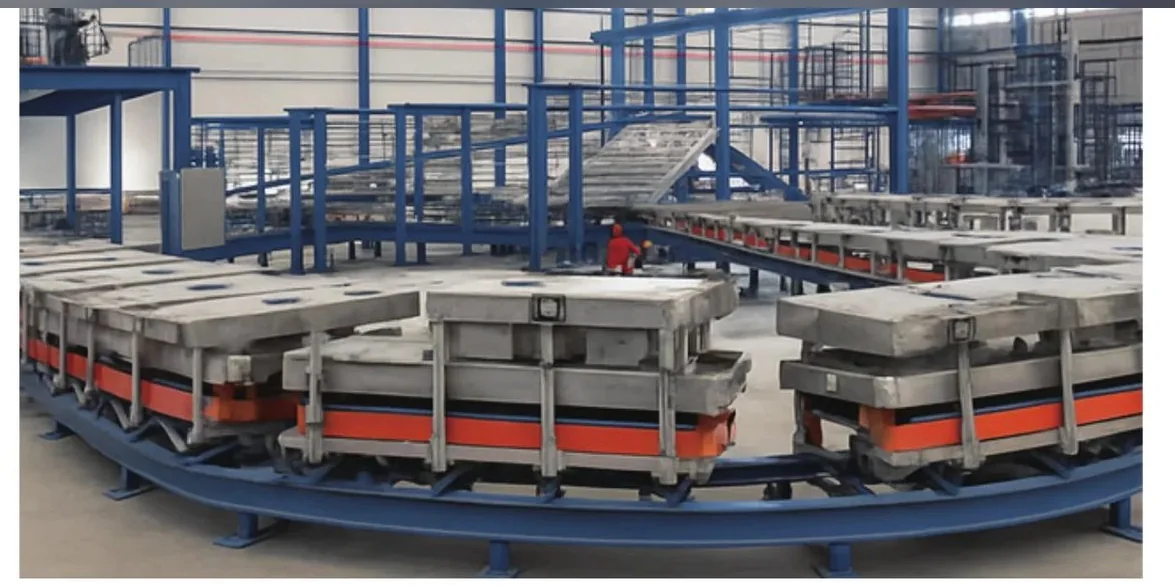
26-Station Ground-Rail Foaming Line Throughput: The Real Math Behind the Numbers
The station count in a foaming line's name is the wrong number to size capacity on. Hourly output is set by takt time and OEE; the 26 stations set curing time and work-in-process. This guide walks the actual throughput math for a closed-loop ground-rail line so you size it against your real production target.
Chef Base PU Foaming, Deep Dive: Why a Load-Bearing Cabinet Is Foamed Differently from a Domestic Fridge
A chef base carries heavy cooking equipment on its top deck, soaks up radiant heat from the cooktop, and is built from two stainless skins — so its PU foam has to be a structural member and an insulator at once. This deep dive walks the engineering that separates chef-base foaming from domestic-cabinet foaming: load-bearing density, k-factor under a hot deck, stainless adhesion, and the defect modes that punish treating the two cabinets the same.

Cigar Humidor Cabinet PU Foam, Deep Dive: Why a Humidity-Holding Cabinet Is Foamed Differently from a Cold-Chain Fridge
A cigar humidor cabinet shares a fridge's two-skin, one-PU-shot construction but not its goal: it holds a narrow 65–72% relative-humidity band at around 18 °C, not a low temperature. This deep dive walks the engineering that makes humidor foaming its own discipline — RH stability, a vapor-tight envelope (ASTM E96 permeance), the condensation a single void causes near saturation, dimensional stability so the door seal stays tight for years, and why it is a precision low-pressure job rather than a high-volume one.