
How Many Foaming Fixtures Does a Refrigerator Production Line Need?
Fixture count is not a units-per-day lookup — it is a line-balancing calculation built from net production time, takt time, and fixture occupation time. Here is the formula, a worked 1,000-cabinet example, and the 14 data points a line supplier needs before quoting fixture quantity.
Required fixtures = fixture occupation time ÷ production takt time. A 1,000-cabinet/shift line with 450 minutes of net production time and a 360-second fixture cycle needs 14 fixtures theoretically, 16–17 in practice once changeover, cleaning and operator variation are built in. Curing time and cabinet size move that number more than daily volume does — and adding fixtures past the real bottleneck (usually the PU machine or the conveyor) buys nothing.
When a factory owner asks us to quote a refrigerator production line, the conversation almost always starts with a target: 500 units a day, or 1,000, or 2,000. The instinct is to translate that number straight into a fixture count. It doesn't work that way.
Fixture quantity is a production-line balancing problem, not a tooling calculation. Two factories building the same 1,000-cabinet daily target can need nine fixtures or eighteen, depending on shift structure, curing time and cabinet size. Below is the formula we actually use when scoping a foaming section, a worked example, and the information we ask for before quoting a line.
What a refrigerator foaming fixture actually does
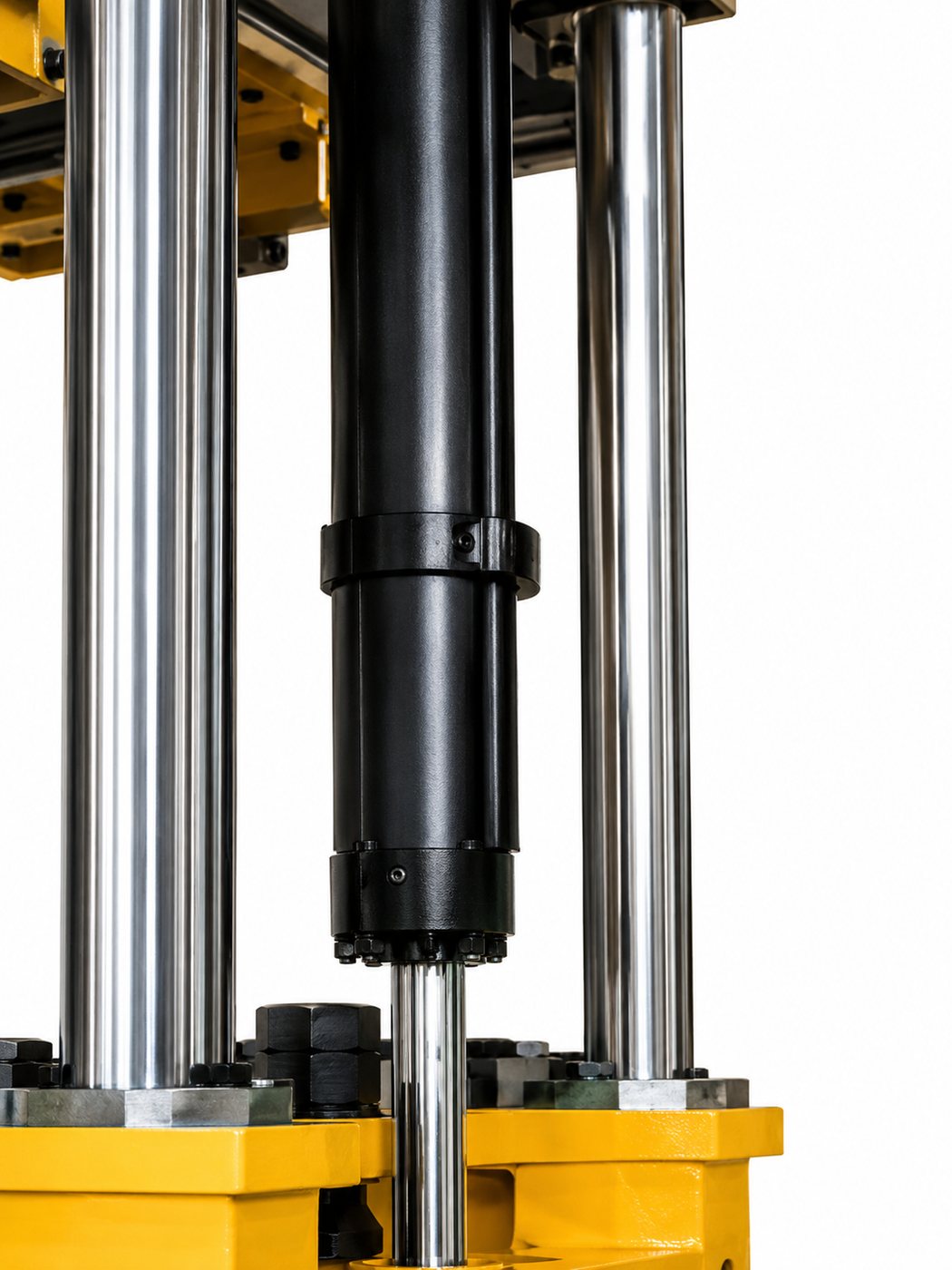
During cabinet production, polyurethane is injected into the cavity between the inner liner and the outer shell. As it expands, it generates real pressure against the cabinet structure. The fixture holds the cabinet in position through that expansion and cure so the finished product keeps its designed dimensions — preventing wall bulging, surface deformation, uneven geometry, poor sealing, misaligned doors and foam-related distortion.
The detail that trips up first-time line planners: a cabinet occupies the fixture far longer than the actual PU injection takes. A mixing head can complete an injection in well under a minute; the cabinet then stays clamped for several minutes while the foam expands and cures. Fixture occupation time, not injection time, is what controls the capacity of the foaming section.
Step 1 — Define target output and net production time
Start with required output — 500, 800, 1,000, 1,500, 2,000 cabinets per shift. That number alone isn't enough. You also need shift count, shift length, and how much of that shift is actually productive once operator breaks, shift handover, material prep, cleaning, minor stoppages, changeover, quality checks and maintenance are subtracted.
| Shift Length | Planned Time | Example Net Production Time |
|---|---|---|
| 8 hours | 480 min | 420–450 min |
| 10 hours | 600 min | 530–570 min |
| 12 hours | 720 min | 640–680 min |
These are planning ranges, not fixed constants — every factory should measure its own real available production time. The ISO 22400 manufacturing-operations KPI standard defines this net-versus-planned distinction formally as part of overall equipment effectiveness reporting, which is worth aligning to if your factory already tracks OEE.
Step 2 — Calculate production takt time
Takt Time = Net Available Production Time ÷ Required Output
Example: a factory targets 1,000 cabinets per shift with 450 minutes of net production time.
450 × 60 = 27,000 seconds → 27,000 ÷ 1,000 = 27 seconds per cabinet
The foaming section needs to release one finished cabinet roughly every 27 seconds to hit the target. This takt number is the denominator for every fixture calculation that follows.
Step 3 — Establish fixture occupation time
Fixture occupation time is the full cycle — loading, positioning, closing, injection, foam expansion, curing, opening, unloading — not the injection alone.
| Process | Example Time |
|---|---|
| Cabinet loading | 30 sec |
| Fixture closing | 15 sec |
| PU injection | 25 sec |
| Foaming and curing | 240 sec |
| Fixture opening | 15 sec |
| Cabinet unloading | 35 sec |
| Total fixture occupation time | 360 sec |
In this example one cabinet occupies a fixture for roughly 360 seconds — 6 minutes. The real figure shifts with refrigerator model, PU formulation, insulation thickness, cabinet size, mould temperature and automation level.
Step 4 — Calculate required fixtures
Required Fixtures = Fixture Occupation Time ÷ Production Takt Time
360 ÷ 27 = 13.3 → round up → 14 fixture positions under ideal conditions.
That's the theoretical floor. Real lines don't run at perfect efficiency every minute — operator loading variation, release-agent application, positioning adjustment, cleaning, changeovers, mixing-head movement, quality checks and maintenance all eat into the margin. A line built to the exact theoretical minimum has zero tolerance for normal variation, which is why a project evaluated at 14 theoretical fixtures typically gets specified with 16–17 positions in practice. This isn't a blanket 10–20% markup rule — the final number should come from the actual process, not a rule of thumb.
Full worked example: 1,000 cabinets per shift
| Production Target | 1,000 cabinets/shift |
| Shift Length | 8 hours |
| Net Production Time | 450 min |
| Required Takt | 450 × 60 ÷ 1,000 = 27 sec/cabinet |
| Fixture Occupation Time | 360 sec (assumed) |
| Theoretical Fixtures | 360 ÷ 27 = 13.3 → 14 |
| Practical Line Planning | 16–17 positions after buffer |
If the cabinet releases faster than 360 seconds, fewer stations may work. If curing runs longer, the line needs more — which is exactly what the next table shows.
Fixture count at different production capacities
Holding net production time (450 min) and fixture cycle (360 sec) constant, theoretical fixture count scales with target output:
| Target Output/Shift | Takt Time | Fixture Cycle | Theoretical Fixtures |
|---|---|---|---|
| 500 cabinets | 54 sec | 360 sec | 7 |
| 800 cabinets | 33.8 sec | 360 sec | 11 |
| 1,000 cabinets | 27 sec | 360 sec | 14 |
| 1,500 cabinets | 18 sec | 360 sec | 20 |
| 2,000 cabinets | 13.5 sec | 360 sec | 27 |
Useful for initial planning — not the final engineering configuration. The actual line still depends on PU machine output, mixing-head cycle, conveyor speed, cabinet dimensions, automation level, product range and available floor space.
Curing time moves the number more than volume does
Hold takt constant at 27 seconds and vary only fixture occupation time:
| Fixture Occupation Time | Theoretical Fixtures Required |
|---|---|
| 240 sec / 4 min | 9 |
| 300 sec / 5 min | 12 |
| 360 sec / 6 min | 14 |
| 420 sec / 7 min | 16 |
| 480 sec / 8 min | 18 |
Two factories producing the identical daily volume can need nine fixtures or eighteen depending on cure cycle alone. Confirm the curing and release behaviour of the polyurethane system before finalising fixture count — it swings the number harder than daily output does.
Cabinet size and mixed-model production both change the math
Small cabinets — lower foam volume, lower shot weight, shorter flow distances, easier handling — can support a shorter cycle. Large cabinets and chest freezers carry more material, longer flow paths, more difficult loading and different fixture geometry, loading orientation and injection position entirely. Units-per-day should never be the only input to fixture design.
Most factories also run several models on one line — a 200 L, 300 L and 400 L refrigerator plus a commercial cabinet, each with different dimensions, shot weight, foam thickness, fixture size and curing time. Mixed-model production adds fixture compatibility, recipe switching, scheduling and changeover time to the calculation, which is why theoretical maximum capacity and real mixed-model output rarely match.
Dedicated vs. adjustable fixtures
| Factor | Dedicated Fixture | Adjustable Fixture |
|---|---|---|
| High-volume production | Excellent | Suitable |
| Frequent model changes | Limited | Better |
| Setup complexity | Low | Higher |
| Initial tooling requirement | Higher for many SKUs | Potentially lower |
| Cycle consistency | High | Depends on setup |
| Production flexibility | Lower | Higher |
More fixtures don't always mean more output
This is the mistake we see most often when a factory tries to expand an existing line by simply bolting on more fixture stations. If the real bottleneck sits elsewhere — the PU foaming machine, mixing-head movement, cabinet loading, conveyor speed, door foaming, vacuum forming, final assembly or testing — additional fixtures only create waiting positions. The system has to be balanced as one line, not optimized fixture-by-fixture.
To check whether the PU machine itself is the constraint: if one cabinet needs 5 kg of mixed PU and injection takes 25 seconds, average output during that injection is 5 ÷ 25 × 60 = 12 kg/min. But machine selection can't rest on that average alone — required instantaneous output, material pressure, ratio stability, pressure recovery, mixing quality, material circulation, cabinet-plus-door demand, mixing-head count and safety margin all factor in, especially when one high-pressure machine serves both cabinet and door production.
One machine can still serve many fixtures. In a typical multi-station sequence, the machine injects Fixture 1, then moves to Fixture 2, then Fixture 3, then Fixture 4, while each previously injected cabinet stays clamped through its cure. The engineering task is matching machine injection cycle, fixture cycle, conveyor movement and takt time so no stage sits idle waiting on another — a form of line balancing consistent with the throughput-KPI framework in ISO 22400.
Layout: linear, ground-rail or rotary
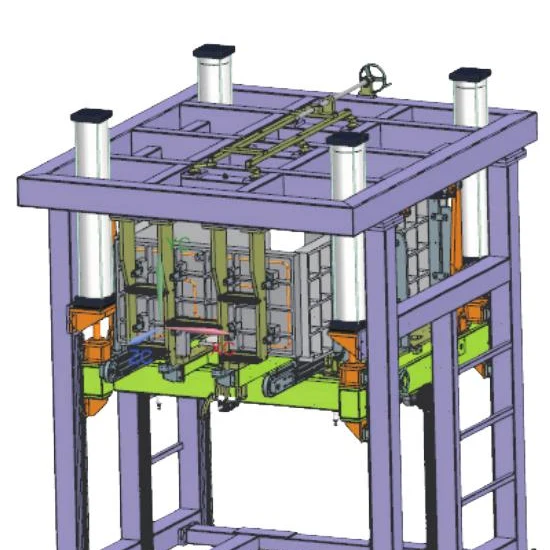
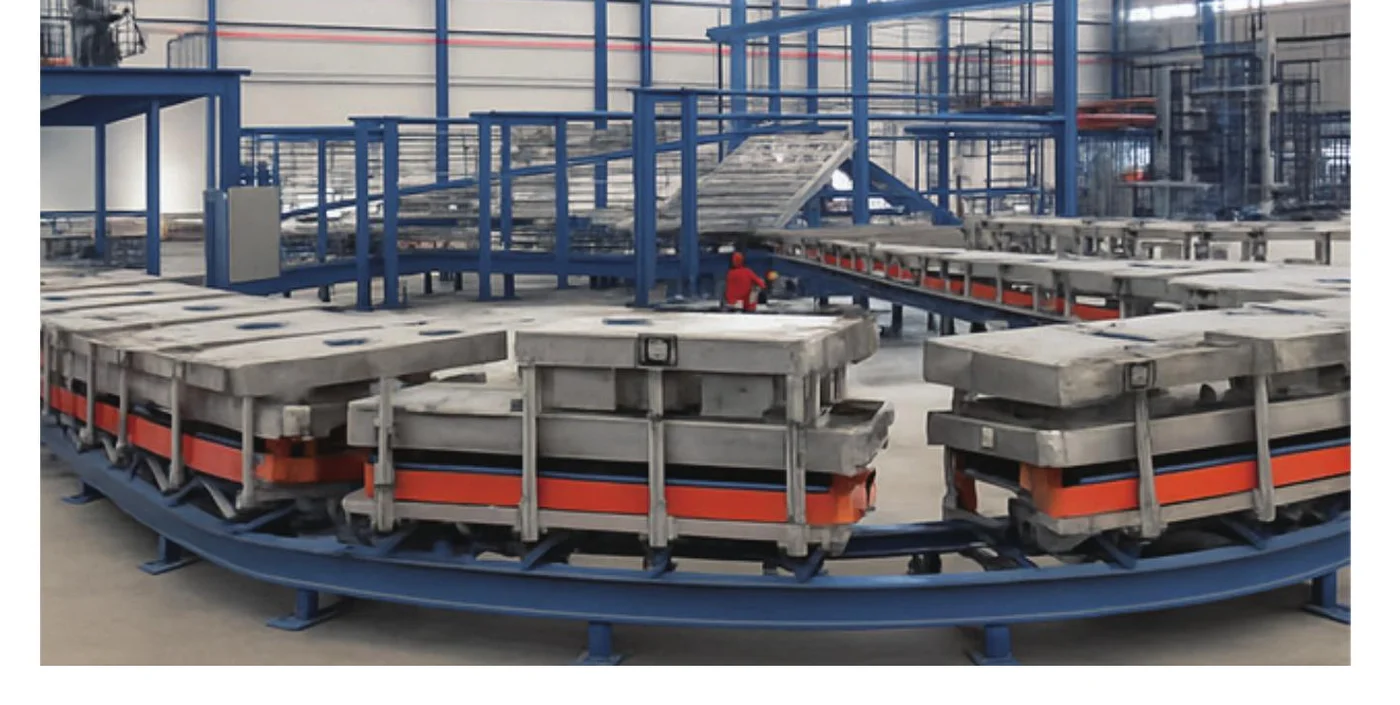
Fixture count also drives physical layout. Linear layouts suit smaller lines, straightforward workshops and lower automation. Ground-rail systems fit multiple fixture stations, medium-to-high output and automated fixture movement on a structured takt. Rotary or carousel arrangements support repetitive production with a fixed sequence and controlled station timing in a compact footprint. The right choice depends on fixture count and available workshop dimensions and material-handling method.
More fixtures also means more rail length, larger footprint, more utility routing, longer mixing-head travel, and more space needed for maintenance access, safety aisles and operator positions — including the loading and unloading zones where cabinet handling actually happens. The CDC/NIOSH guidance on manual material handling is a useful reference when specifying loading-station ergonomics for a fixture count in the high teens or twenties, where repetitive cabinet handling becomes a real operator-fatigue factor. A line that looks fine in a spreadsheet may not fit the building — evaluate fixture count together with a preliminary factory layout, not after it.
Cabinet and door foaming are two separate calculations
A finished refrigerator isn't only a foamed cabinet — the doors need insulation too, with their own shot weight, fixture size, mould count, production ratio and curing cycle. A two-door unit needs 1 cabinet + 2 doors per finished refrigerator, so cabinet capacity cannot be used to derive door fixture count. Balance the two separately, then evaluate together when deciding whether one or multiple PU foaming machines are required.
What we ask for before quoting fixture quantity
- Refrigerator type
- Cabinet dimensions
- Number of models
- Target output per shift
- Number of shifts per day
- Net available production time
- PU foam density
- Shot weight per cabinet
- Required fixture curing time
- Loading and unloading method
- Number of doors per refrigerator
- Available workshop dimensions
- Existing PU equipment, if any
- Required automation level
With those fourteen data points, a production-line supplier can evaluate far more than fixture count alone — PU machine output, cabinet-plus-door configuration, rail layout, workshop space and automation requirements all follow from the same numbers.
Conclusion
Fixture quantity isn't a lookup from daily volume — it follows a sequence: target output → net production time → required takt → fixture occupation time → theoretical fixture count → capacity buffer and line balancing → final configuration. Too few fixtures caps output; too many adds investment, floor space and system complexity without moving the real number. A well-balanced line matches fixtures, PU foaming machine capacity, material handling, cabinet-plus-door production, automation and workshop layout to each other — not to a single target-output figure in isolation.
If you're planning a new refrigerator factory or expanding an existing foaming line, send us your target daily output, refrigerator models, cabinet dimensions, PU shot weight, working schedule and available workshop size. We'll work out the required foaming fixture quantity, PU machine capacity, production takt and recommended line layout for your project.
Prêt à planifier votre projet frigorifique ?
Indiquez-nous votre objectif de production et votre gamme de produits — notre équipe répond avec un plan de capacité et un devis sous trois jours ouvrés.
Demander un devis techniqueArticles associés
Cold Room Panel Manufacturers in the UAE: Why "Civil Defence Approved" Is Not One Question
In the UAE, a panel's paperwork has to satisfy a federal code, a product certification scheme, and an emirate-level listing — and Abu Dhabi has just formalised 54 local amendments of its own. A brochure line reading "Civil Defence approved" answers none of those three. Here is what to ask instead, why a European supplier's fire pack is the wrong currency here, and what a 45°C ambient does to the thickness you thought you needed.
Converting a Refrigerator Foaming Line to Cyclopentane: Retrofit vs New Machine, Cost and Timeline
Switching from HFC-245fa to cyclopentane is an equipment and safety-infrastructure project, not a raw-material swap. Here's how to decide between retrofitting an existing foaming machine and buying a new cyclopentane-ready one, what the safety infrastructure actually costs, and a realistic project timeline.
Freezer Mould Selection Guide: Chest vs Upright vs Display Cabinet
A freezer mould is not one product — chest (horizontal), upright and display (island / glass-door) freezers each need a different mould geometry, clamping load and cure schedule. This guide picks the right freezer mould family by cabinet size, volume and operating temperature.