
Spray Foam Equipment for Cold Storage Insulation — -certified pu foaming machines by UREXCEED, manufactured under an ISO 9001-certified quality management system. Lead time 30 – 45 days, MOQ 1 set.
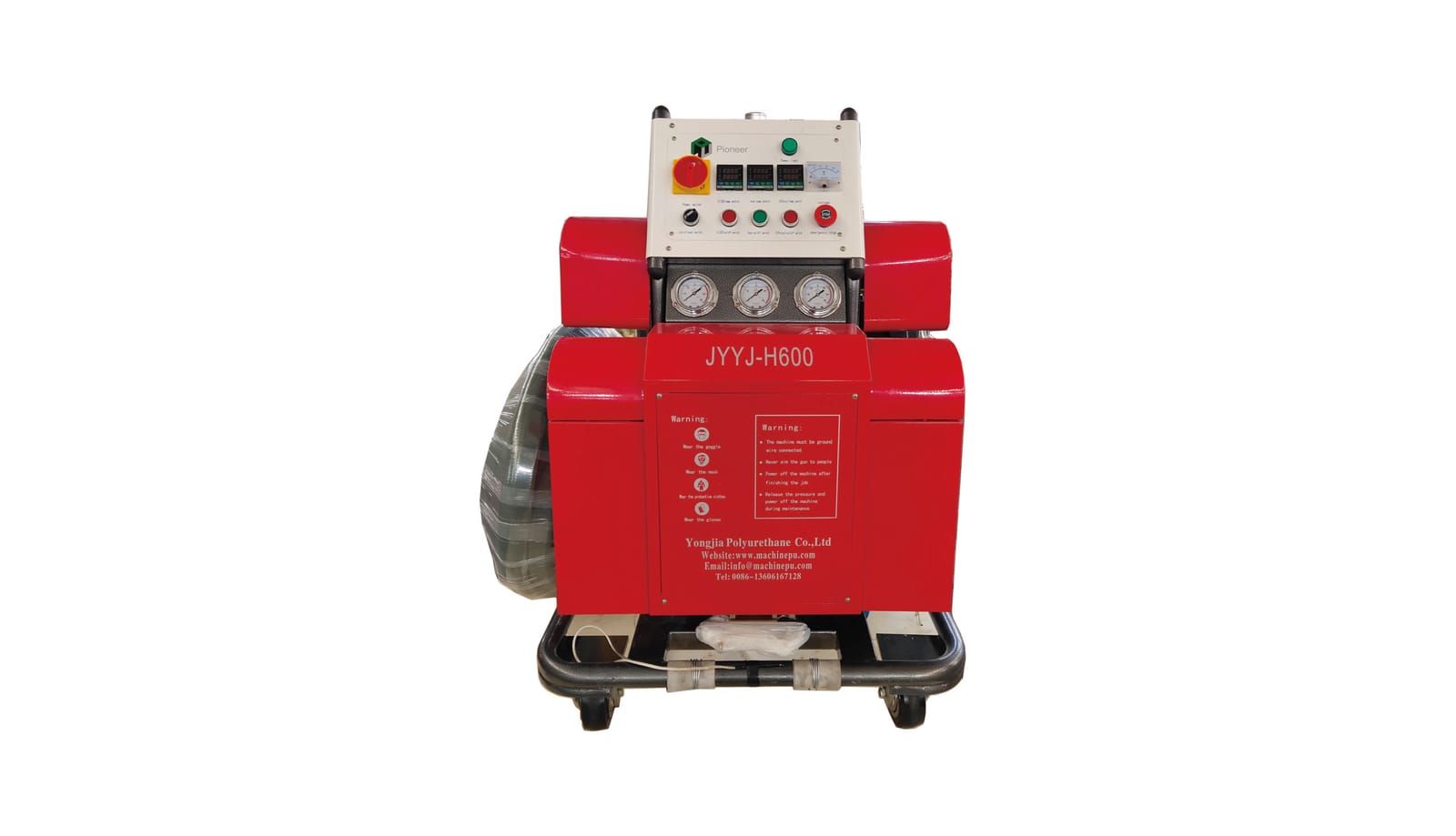
Spray Foam Equipment for Cold Storage Insulation
Spray foam for the refrigerator cabinets a high-pressure machine can't reach — oversized supermarket islands, curved commercial freezers, thick-wall ultra-low-temp boxes, on-site liner repair. 5–20 kg/min.
Engineering reply within 24 hours
Quote + spec sheet + tailored sizing recommendation. WhatsApp answered 9 am–6 pm Beijing time.
Specyfikacja techniczna
- Output
- 5 – 20 kg/min (typical refrigerator spray rate: 8–12 kg/min)
- Output Pressure
- 100 – 160 bar at the gun
- Heating
- Electric hose heating, full-length 80°C ±3°C
- Hose Length
- 10 / 20 / 40 / 60 m configurable
- Gun Spray Pattern
- Adjustable fan, 15° – 60° cone, single-pass thickness 10 – 25 mm
- Metering Ratio Accuracy
- ±1.5% (electronic proportioner)
- Recipe Compatibility
- Spray-grade polyol (high viscosity, fast gel, 3–5s tack-free)
- Operating Window
- 15 – 35°C ambient, < 75% relative humidity (ideal cabinet substrate ≥ 18°C)
- Configuration
- Mobile cart / 20' container-mounted / fixed in-line — pick by factory layout
- Operator Safety Pack
- Supplied-air respirator, Tyvek suit, butyl gloves, MDI vapor detector
- Power
- 380V / 480V · 50/60Hz, 8 – 16 kW (depending on heating zones)
- Daily Spray Area (50mm thick)
- 50 – 120 m² per operator per shift
Zastosowania
- Large supermarket island freezer (2–4 m, irregular inner shells)
- Long open-top commercial display cabinet (8–12 m, single piece)
- Curved / dome-shaped commercial freezer inner walls
- Pharmaceutical / vaccine ultra-low-temp freezer (-86°C, thick-wall 50–80 mm)
- On-site repair of refrigerator inner liner defects (bubbles, sink marks before export)
- Large chest freezer (800L+) — too big for standard moulds
- Refrigerated truck body insulation (sibling product line at refrigerator factories)
- Cold room panel & joint foaming
When a refrigerator factory actually needs a spray foam machine
Most refrigerators get foamed in closed moulds with a high-pressure machine. Spray foam is for the cabinets where the closed-mould approach hits a wall. Four clear cases:
Oversized cabinets
Cabinet too big for a practical mould. Supermarket island freezers, 2–4 m long open-top display cases, walk-in commercial cabinets. A 4m steel mould costs USD 150K+ and weighs tons. Spray foam handles the same job at a fraction of the capex.
Irregular geometry
Irregular or curved geometry. Curved-front commercial freezers, dome-shaped display refrigerators, faceted product-specific cabinets where a closed mould would need 6+ parting surfaces.
Thick walls
Thick walls (over 50mm). Pharmaceutical / vaccine ultra-low-temperature freezers (-86°C) need 60–80mm of insulation. A closed mould at that thickness has cure-time and stress problems. Spray-applied multi-layer foam handles thick walls cleanly.
On-site work
On-site work. Refrigerator inner liner defect repair (bubbles, sink marks discovered before export), retrofit insulation on existing cabinets, custom one-off cold rooms attached to refrigerator factories.
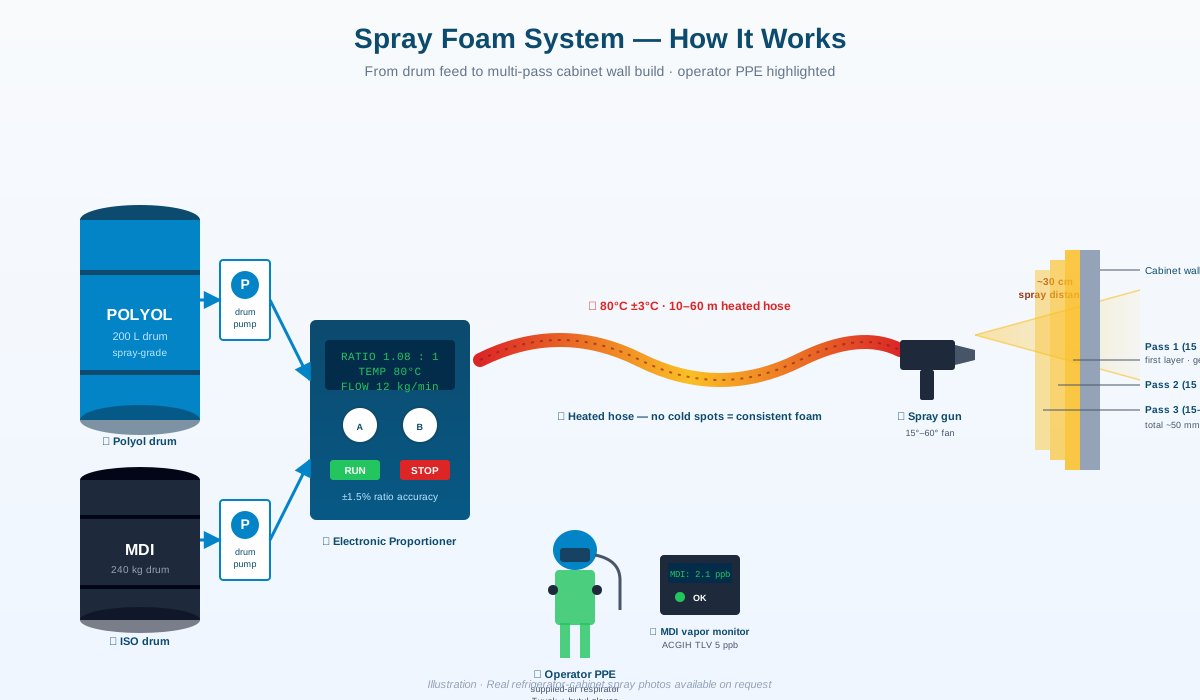
Our spray gun and heated hose system
The gun and the heated hose are the parts of the machine where most quality problems start. We use proven, commercially-available components for both.
Spray gun
Spray gun: industrial-grade, comparable in design to Graco Fusion / Wagner GX class. Air-purge head (no solvent flush needed), variable fan pattern 15°–60°, replaceable mix chamber. Replacement gun tips and mix chambers are stocked in our spare parts depots.
Heated hose
Heated hose: full-length electric heating with PID control, ±3°C across the entire hose length. Available in 10 / 20 / 40 / 60m configurations. Properly heated hose = consistent foam; a "cold spot" in the hose causes poor mixing and bad cell structure.
Electronic proportioner
Electronic proportioner with ±1.5% ratio accuracy. Polyol-to-ISO ratio is critical for spray foam — drift outside ±2% and you get under-cured surface foam (sticky, weak) or over-cured (brittle, dusty).
Tank feed
Drum-direct or day-tank feed. Drum-direct is simpler (drop pumps into 200L drums); day-tank is needed for high-volume continuous spraying or when you're drawing from bulk storage.
PLC control
PLC with recipe storage (typically 10–20 recipes). Stores temperature, pressure, ratio setpoints per polyol grade.
Five refrigerator scenarios we ship this machine for most
Here's where this machine actually goes in refrigerator factories — these account for ~80% of the units we ship.
Supermarket island freezers
Supermarket island freezers (open-top, 2–4 m long). Foam volume 30–80 kg per cabinet, sprayed in 30–60 minutes. Typical sprayer output 100 island cabinets per week, single operator.
Long commercial displays
Long commercial display cabinets (8–12 m single-piece, retail freezer aisles). Foam volume 80–150 kg per cabinet. These are often single-piece custom orders, where a mould investment makes no sense.
Ultra-low-temp pharma freezers
Pharmaceutical / vaccine ultra-low-temperature freezers (-86°C, thick-wall 50–80 mm). Foam volume 40–70 kg per cabinet, sprayed in 2–4 layers.
Inner liner repair
Inner liner defect repair on finished refrigerators. Quick spot-spray of bubbles, voids, sink marks before export. Recovers 2–5% of cabinets that would otherwise be scrapped — significant on a 500K-unit/year factory.
Large chest freezers
Large chest freezers (800L+) and walk-in commercial cabinets where a closed mould would weigh too much to be practical.
Spray vs press foam — the honest comparison
Spray is a different process. Different cell structure, different density, different k-factor. Worth being clear about what you gain and lose.
| Metric | Spray-applied | Press / mould foamed |
|---|---|---|
| k-factor (W/m·K) | 0.022 – 0.024 | 0.018 – 0.020 |
| Molded density (kg/m³) | 40 – 50 | 32 – 38 |
| Closed cell content | 88 – 92% | 95%+ |
| Cabinet wall thickness range | 20 – 100 mm flexible | typically 35 – 60 mm |
| Setup cost per cabinet design | Low (no mould) | High (USD 30K – 200K mould) |
| Output rate | Slower (sprayer-limited) | Faster (mould cycle) |
So: spray foam for cabinets where you can't practically build a mould or where you only need a few units of a design. Press foam for high-volume mainstream refrigerators. The slight loss in k-factor (about half an energy class) is the trade for the geometric flexibility.
Mobile, containerized, or stationary — three deployment patterns
How you deploy the machine inside (or outside) your factory matters as much as the machine spec itself.
Mobile cart configuration. Whole machine on industrial wheels, 1.5 × 1 m footprint. Roll it to where the cabinet is, plug into a nearby socket and air supply. Best for low-volume operations where the cabinet doesn't fit through a doorway to the foaming room. Most popular for repair work and one-off custom cabinets.
20' container-mounted configuration. The entire machine + air compressor + drum storage lives inside a shipping container. Drive the container to a temporary site (large display cabinet install at a supermarket, a custom cold room project), open the doors, run spray hoses out to the work zone. Used by refrigerator factories that do on-site installation work.
Stationary in-line configuration. Machine bolted to the factory floor, multiple spray hoses fed to dedicated spray booths. Best for refrigerator factories that have a dedicated spray foam product line (e.g. supermarket island freezers as a continuous product).
MDI exposure and operator safety — the biggest single risk
Of all the equipment in a refrigerator factory, the spray foam machine has the highest occupational health risk. Atomized MDI aerosol is genuinely hazardous to lungs. Done right it's manageable; done wrong it causes long-term respiratory damage. We don't sell this machine without the safety pack.
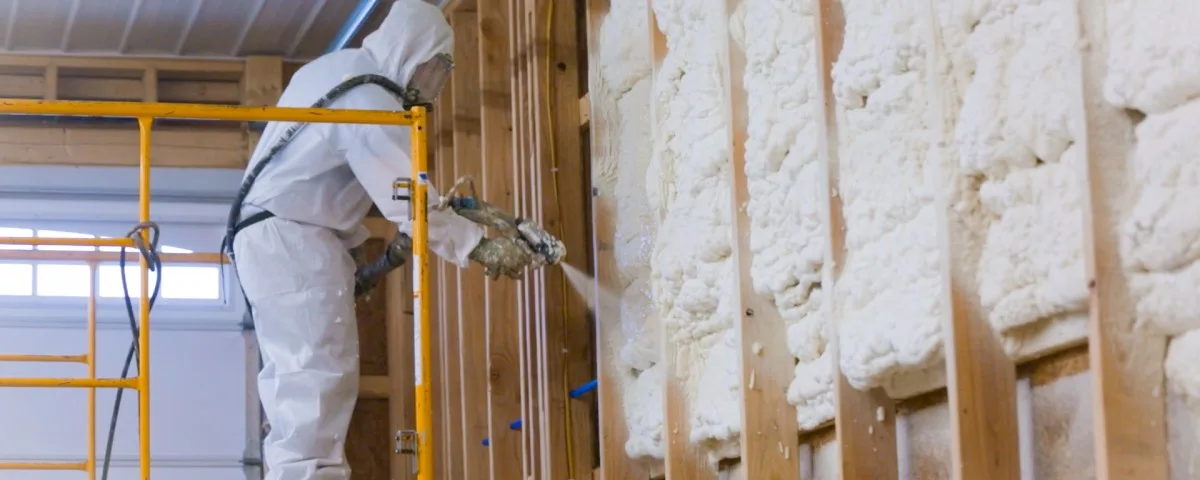
Supplied-air respirator
Supplied-air respirator (positive-pressure full-face hood with hose-fed clean air from outside the spray zone). NIOSH-approved. This is the only respirator that reliably keeps MDI exposure below ACGIH TLV (5 ppb). Filter cartridges are not sufficient for sustained spraying.
PPE (Tyvek, gloves, boots)
Tyvek coverall, butyl gloves, boot covers. Disposable, replaced every shift. MDI penetrates ordinary cotton/nylon fabric.
MDI vapor monitor
Real-time MDI vapor monitor at the spray zone perimeter. Calibrated to ACGIH TLV. Triggers alarm if vapor leaks outside the spray booth (usually means ventilation failure).
Spray booth ventilation
Spray booth ventilation design spec we provide: minimum 6 air changes per hour, exhaust at floor level (MDI aerosol settles), inlet air at ceiling level. Booth pressure slightly negative to surroundings.
Medical surveillance
Recommended (and required in many EU countries) annual medical surveillance for sprayers — lung function testing, respiratory symptom questionnaire. We can connect you with occupational health providers.
Operator training
Operator training covers: putting on PPE in correct order, breathing apparatus checks, what to do if a hose fails or the monitor alarms, decontamination procedure at end of shift. Initial training 3–5 days, refresher every 6 months.
Compatible PU formulation — spray-grade is different
You can't use your high-pressure cyclopentane polyol on a spray machine. Spray foam needs a chemistry that gels in 3–5 seconds (not 40–60), has higher viscosity (so it sticks to vertical walls instead of running down), and uses a different surfactant balance. We supply the matching system.
Fast gel time
Cream 2–4s, gel 3–6s, tack-free 8–15s. About 8–10× faster than press-foam recipes. This is what lets you build up 50mm of foam in 2–3 passes without it sagging.
Higher viscosity
Polyol viscosity 6,000–12,000 mPa·s (vs 3,000–6,000 for press foam). Higher viscosity = better vertical-wall hang.
Higher density
Free-rise density 35–45 kg/m³ (vs 22–28 for press foam). Higher density compensates for the lower cell-structure quality.
HFO over cyclopentane
HFC-245fa or HFO-1233zd(E) are the standard blowing agents for spray. Cyclopentane is technically possible but the open-air spraying creates an explosion risk that's much harder to mitigate than in a closed-mould setup. Most spray operations use HFO.
Operator training — this isn't a "press the button" machine
Spray foam is a craft skill. A good sprayer's output is double a beginner's, and quality is much more consistent. We send a trainer to your factory for 2 weeks of supervised training before unattended production.
Spray distance
Spray distance: 30 cm ±5 from substrate. Too close → uneven thickness, splash-back. Too far → cold spots, poor adhesion.
Fan angle
Fan angle: matched to substrate. Wide fan (50–60°) for flat walls. Narrow fan (15–25°) for corners and edges.
Pass overlap
Pass overlap: 50% with the previous pass. Less than 50% → striping pattern in finished foam. More → uneven thickness.
Multi-layer build
Multi-layer build: wait for previous layer to gel (touch test) before next pass. Typical wait 30–60s. Skipping this wait causes heat buildup, foam structure damage.
Pattern direction
Pattern direction: alternate orientation each layer (horizontal pass 1, vertical pass 2, horizontal pass 3). Helps even out thickness variance.
Production ramp
Production ramp: new sprayer reaches steady quality at about day 7. Full production speed about day 14. We stay through both stages.
Powiązane produkty
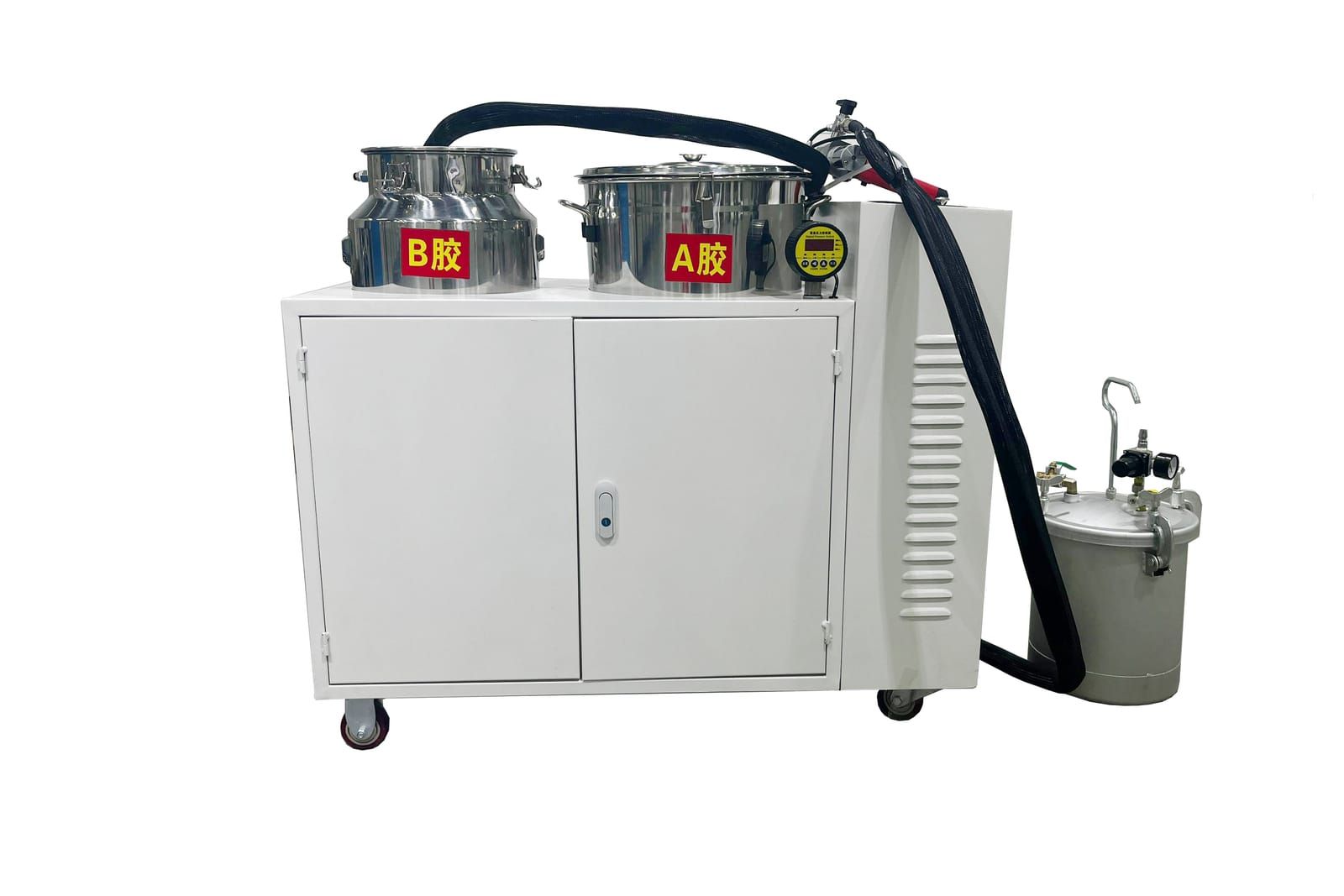
Two-Component PU Adhesive Dispenser — Cold Room Panel Lamination
Built specifically for cold room sandwich panel production — bonds the steel facing to the PU foam core with two-component PU adhesive. 500–2,500 m² of panel per shift, ±1% mix ratio, integrates into continuous or discontinuous panel lines.
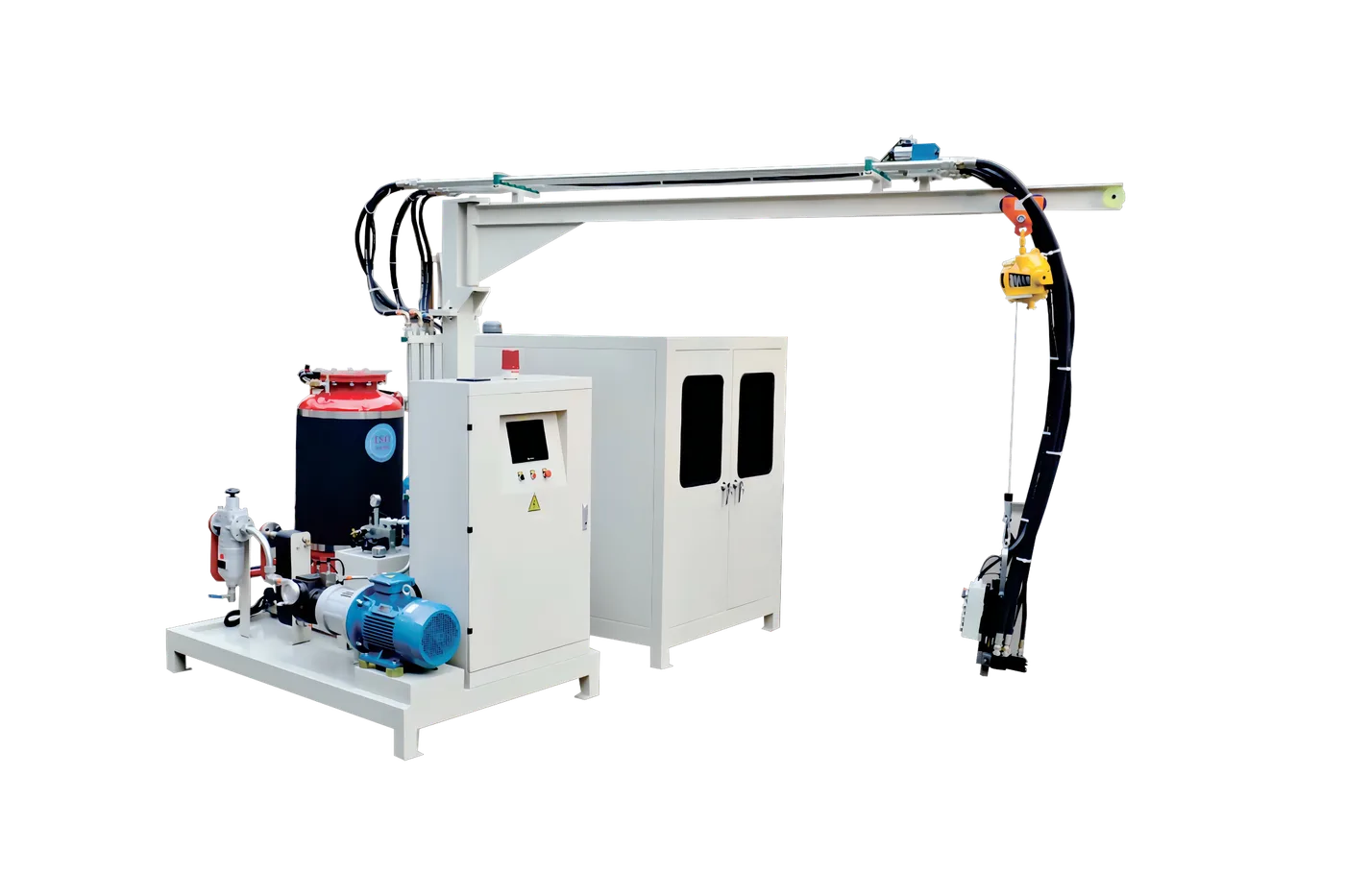
Cyclopentane High-Pressure PU Foaming Machine
Our flagship — purpose-built for refrigerator factories chasing the top EU energy classes (B–C on the 2021 A–G label, formerly A+++). Cyclopentane-ready out of the box with full ATEX Zone 1 safety package. Three sizes covering 500 to 8,000 cabinets a day.
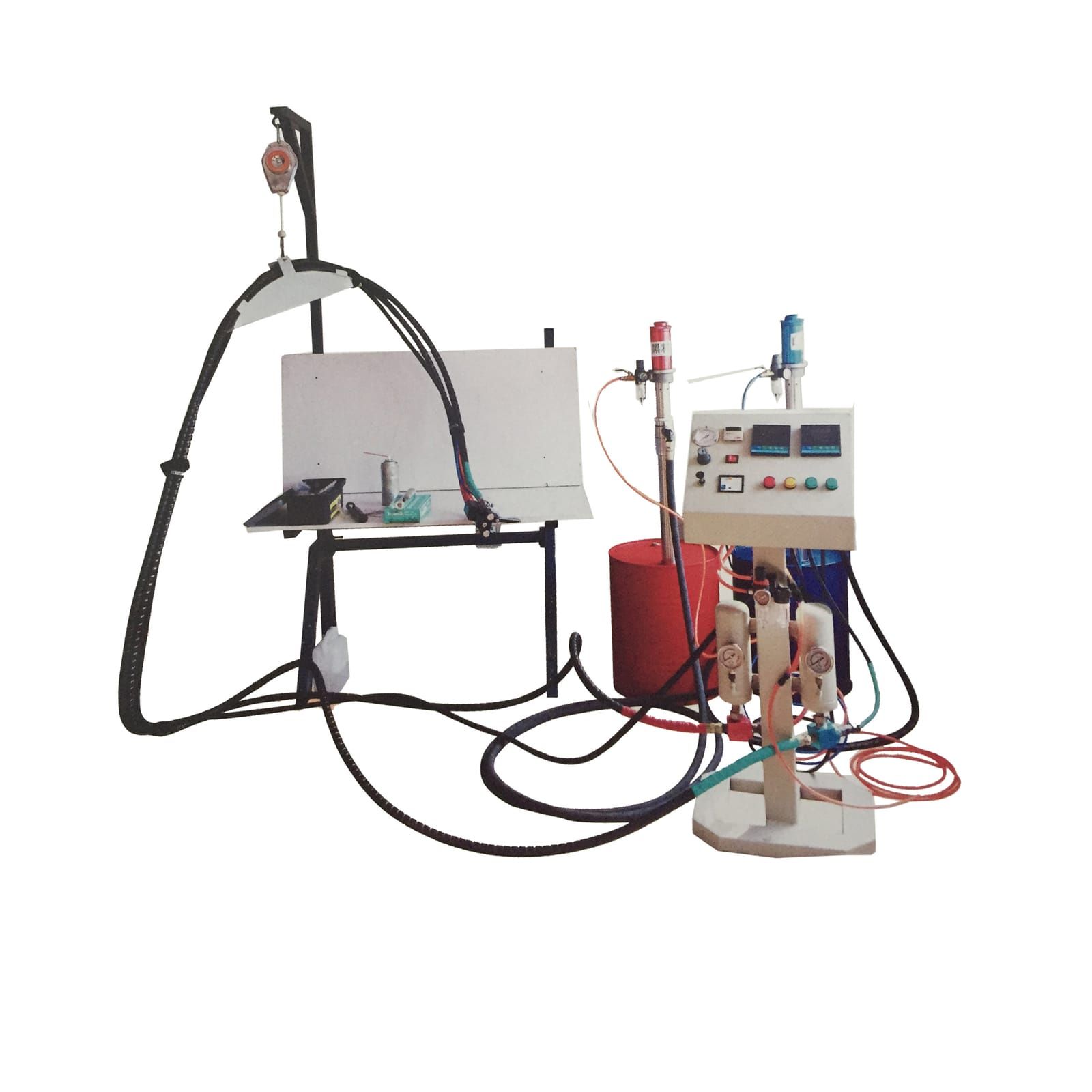
Low-Pressure PU Foaming Machine
Smaller, more flexible machine for wine cabinets, mini-bars, vaccine boxes and R&D pilots. Quick recipe switches when you run dozens of small cabinet variants. 5–250 g/s output.
Cross-Sell · One-Partner Synergy
Pair This Foaming Machine With Moulds + Materials
Foaming machines run best on properly engineered moulds and calibrated raw materials. Buy together for full-line synergy.
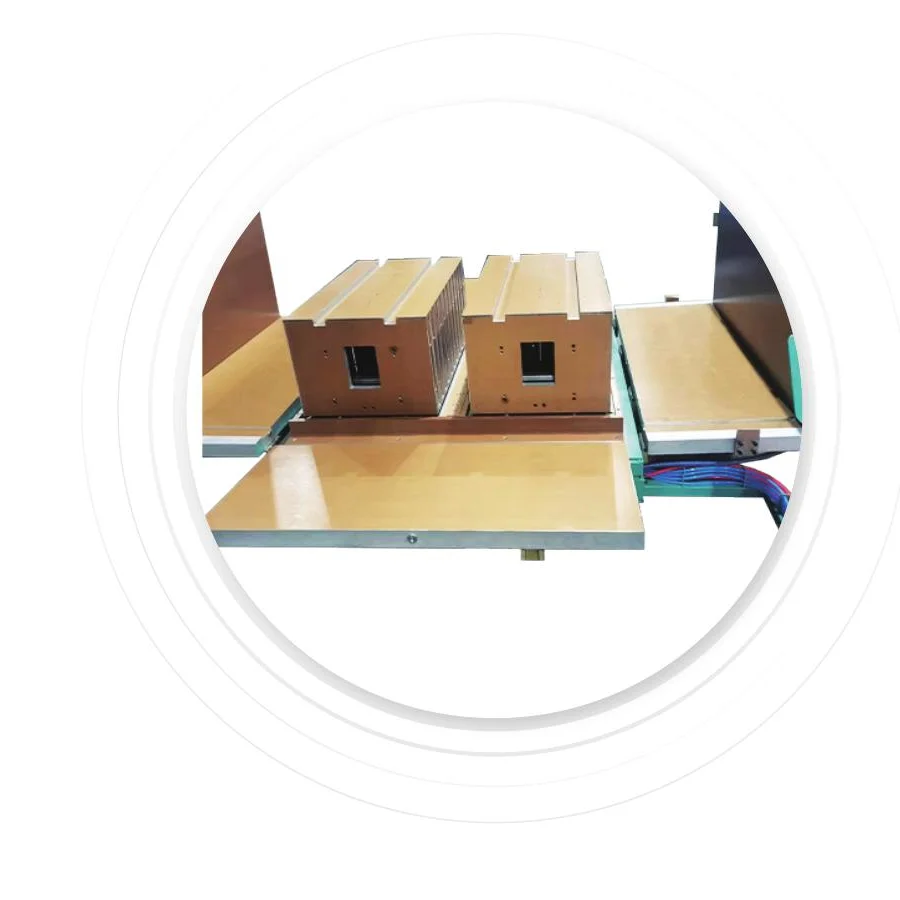
Refrigerator-Grade Moulds
Vacuum-forming moulds for inner liners + foaming moulds for cabinet/door — 30-year cluster network.
Learn more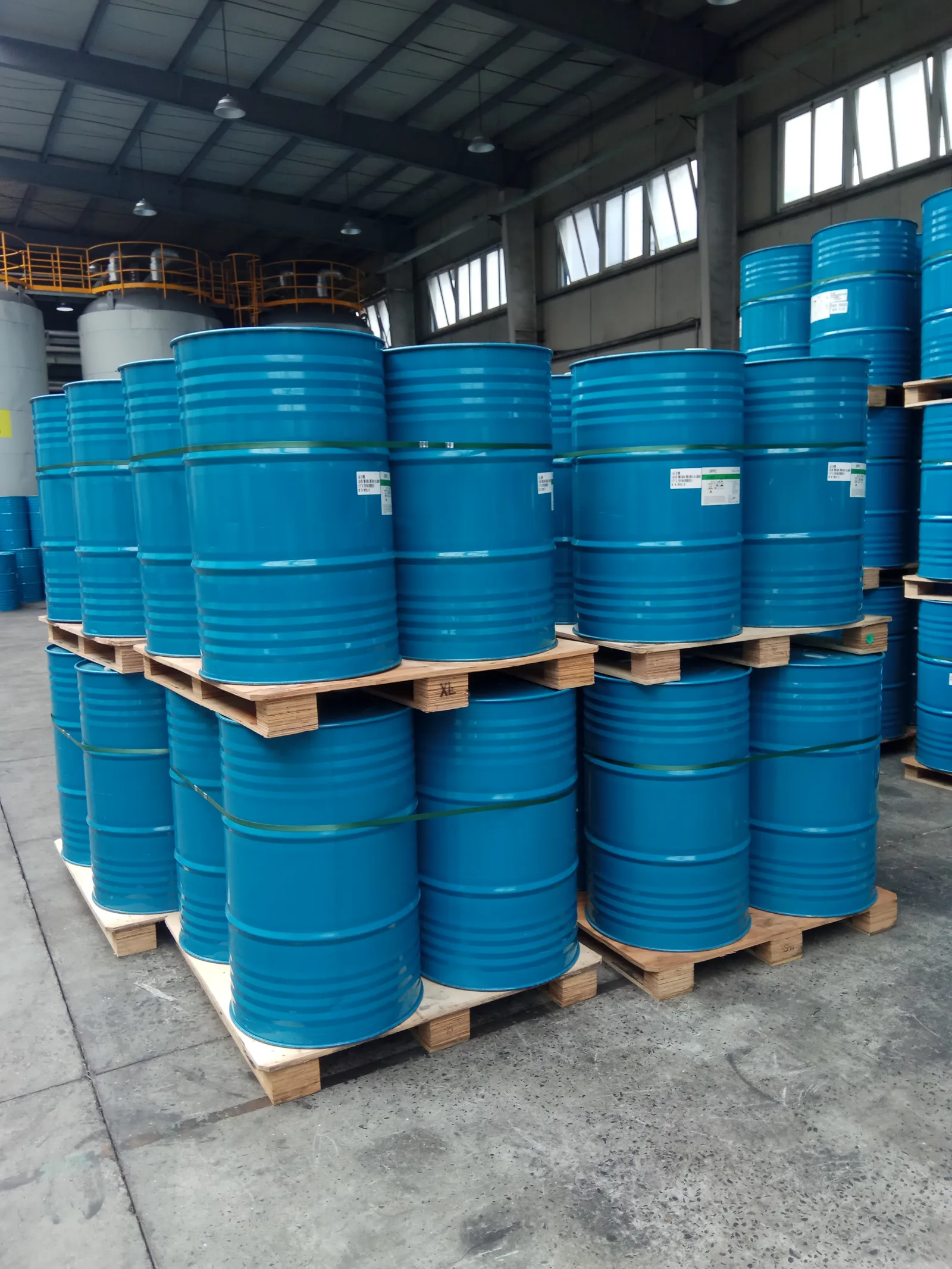
PU Raw Materials
MDI + Polyol formulations matched to your machine output, density target, and local climate.
Learn more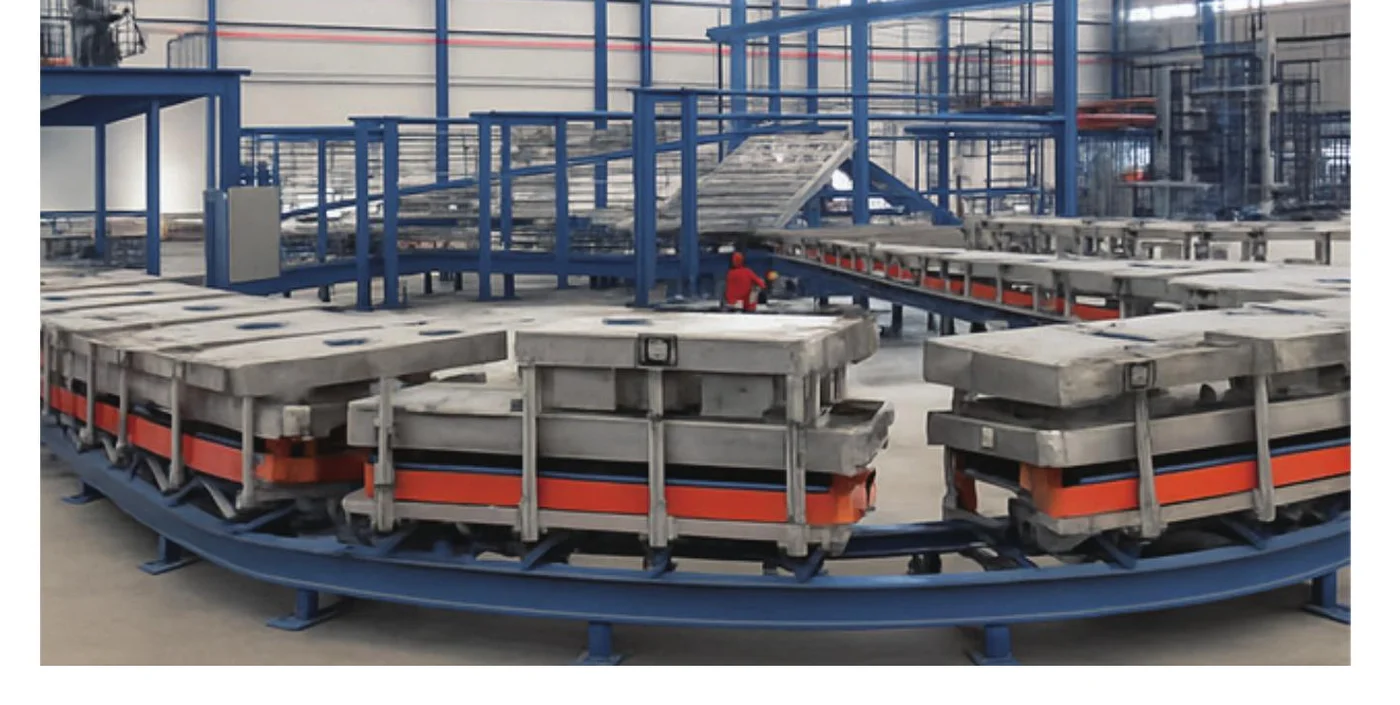
Refrigerator Production Line
Cyclopentane high-pressure foaming is the heart of our turnkey refrigerator factory solutions.
Learn moreService & Support
Warranty & Service
On-site intervention available in every region where we have delivered projects.
On-Site Installation
Our engineers fly to your factory to supervise installation, layout verification, and first-run production.
Commissioning + Tuning
Trial run + parameter tuning to your local raw material, climate, and target product spec — until throughput meets contract.
Operator Training
5-10 day on-site training for production team, QC, and maintenance — bilingual manuals + video tutorials provided.
3-Year Warranty + Spares
Core equipment 3-year warranty, electrical 2-year. Spare parts in stock with global express shipment 24h dispatch.
Często zadawane pytania
Spray vs press-foam — what do I lose, what do I gain?
My factory makes supermarket island freezers, 3 meters long. Spray or press?
How long does an operator need to train before spraying production cabinets?
MDI vapor exposure — is this safe for my operators?
How much foam can one operator spray per shift?
I need 50mm of foam thickness. How many passes?
Does ambient temperature affect what we can spray?
Can I use the same polyol system as my high-pressure cyclopentane machine?
What's the annual spare-parts cost?
Can I use this machine to repair the inner liner of a finished refrigerator that has a defect?
Potrzebujesz kompleksowego rozwiązania chłodniczego?
UREXCEED integruje formy, maszyny do pianki, linie produkcyjne i materiały z 6 fabryk partnerskich. Podaj cel kapacytetowy, w 24h przedstawimy konfigurację i wycenę.