
26-Station Ground-Rail Foaming Line Throughput: The Real Math Behind the Numbers
The station count in a foaming line's name is the wrong number to size capacity on. Hourly output is set by takt time and OEE; the 26 stations set curing time and work-in-process. This guide walks the actual throughput math for a closed-loop ground-rail line so you size it against your real production target.
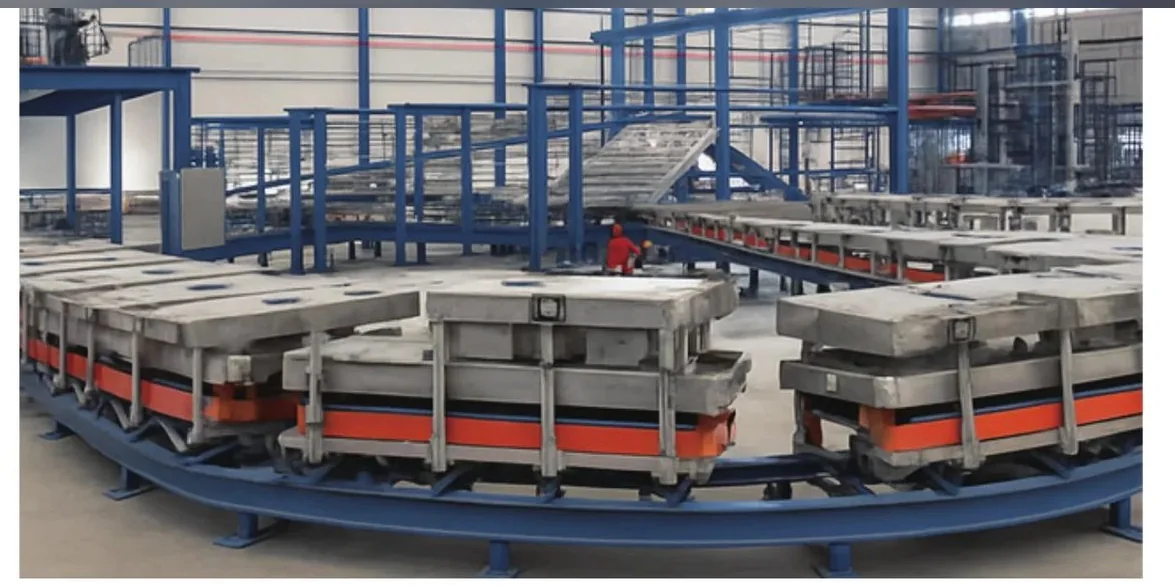
A 26-station ground-rail PU foaming line's output rate is set by one variable — the 20-second takt (3,600 ÷ 20 = 180 parts/hour theoretical), not the station count. The 26 stations set the fill time (26 × 20 s ≈ 8.7 minutes, which equals the foam's curing budget) and the work-in-process (Little's Law: ~26 parts in process). Real output = theoretical × OEE; at a realistic 80% OEE that's ≈ 144 doors/hour. Adding stations never raises the rate — only a shorter takt or higher OEE does. Confirm which unit a capacity figure counts (door, lid, body or finished cabinet) before trusting it, and size the line from your required parts/hour, derived from annual volume and shift pattern.
"How many refrigerators can a 26-station ground-rail foaming line make?" is the first question almost every OEM buyer asks — and the station count in the name is the wrong number to anchor on. A foaming line's hourly output is set by one variable: the takt time, the interval between stations indexing. The 26 stations decide something different — how much work-in-process the loop holds and how long it takes to fill. Confuse the two and you will either overpay for capacity you can't use or underbuild a line that bottlenecks the rest of the factory. This guide walks through the actual throughput math for UREXCEED's closed-loop ground-rail line so you can size a line against your real production target, not a headline figure.
Why "26 stations" is not your output number
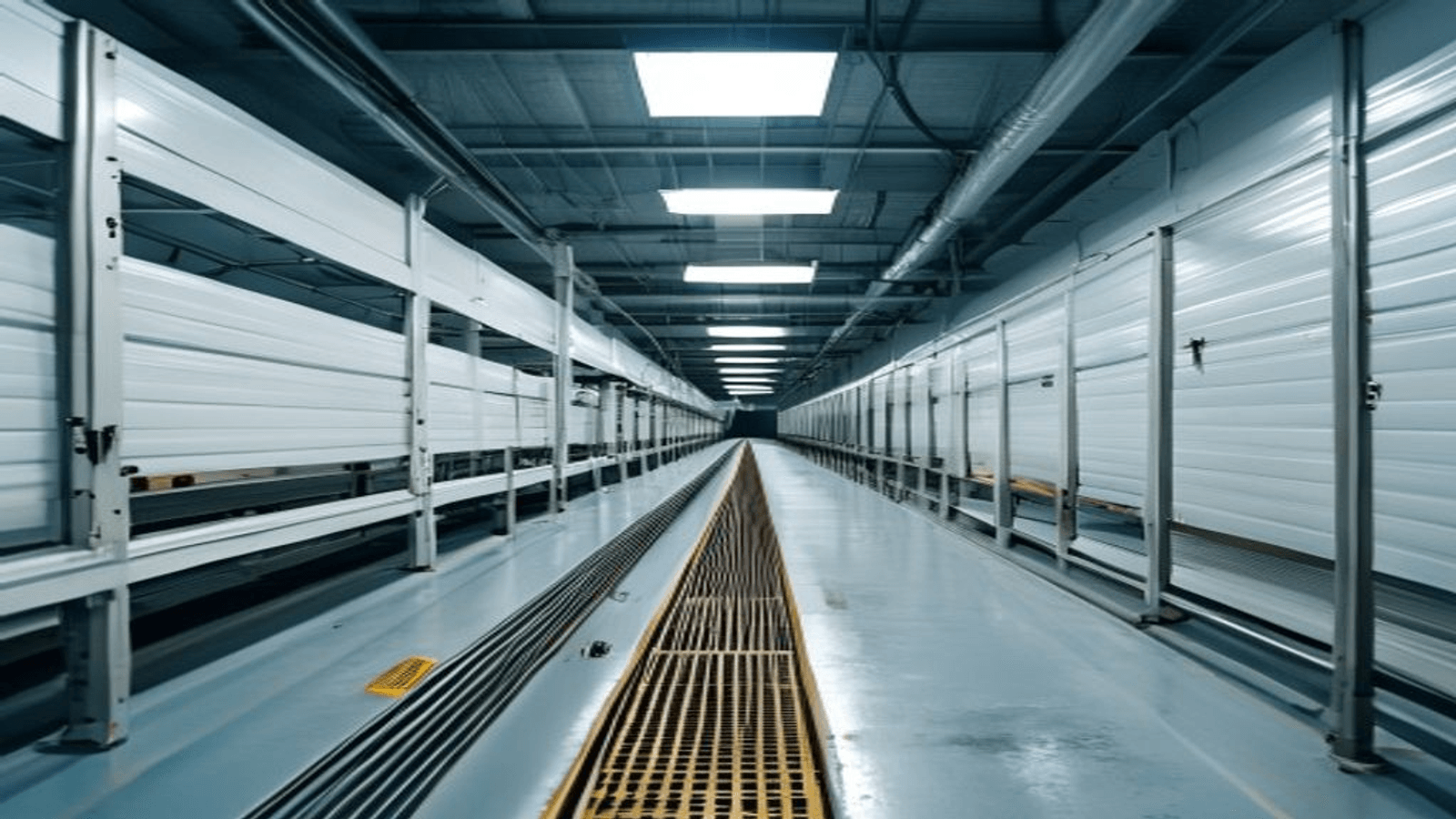
The closed-loop ground-rail line carries 26 door-fixture carriers on a continuous steel rail around the foaming room. They index forward one position at a time, a fresh part is poured and clamped, and after curing each carrier returns to the load point without backtracking. It is an elegant layout, and the "26" is real — but it describes the length of the conveyor, not the rate at which finished parts come off it. A line with 26 stations and a 20-second takt produces exactly the same parts-per-hour as a hypothetical line with 40 stations and the same 20-second takt. The extra stations would only change how many parts are in process at once and how long curing can run. Over three decades and 1,800+ projects across 40+ countries, the single most common sizing mistake UREXCEED sees is buyers reading station count as throughput. So let us separate the two numbers cleanly.
Takt time: the one number that sets your rate
Takt is the heartbeat of the line — the fixed interval at which every carrier advances one station. On the ground-rail line that interval is 20 seconds per cabinet (excluding manual operation time). Everything about hourly output flows from it:
Theoretical parts per hour = 3,600 ÷ takt (seconds)
At a 20-second takt: 3,600 ÷ 20 = 180 parts per hour, or 3 parts per minute, at 100% efficiency.
That 180/hour is a ceiling, not a promise — it assumes the line never stops, every pour is good, and there is always an operator and a fixture ready. No real line runs at its ceiling, which is exactly why the efficiency factor below matters more than any brochure number. But takt is where sizing starts: halve the takt and you double the rate; the station count does not enter this equation at all.
What 26 stations actually buy you: fill time and curing
If stations don't set the rate, what do they do? Two things, both important. First, they set the fill time — how long it takes a part to travel the whole loop:
Fill time = stations × takt
26 stations × 20 seconds = 520 seconds ≈ 8.7 minutes for a part to go all the way around.
That number is the line's curing budget. PU foam needs time in a warm fixture to rise, gel and stabilise before demoulding — the ground-rail line holds its carriers in a 55 ± 5 °C curing zone as they travel. The number of stations is chosen so that fill time equals the curing time the foam chemistry requires at the line's takt. Too few stations at a fast takt and parts reach the load point before the foam has set; too many and you are paying for steel and floor space you don't need. The "26" is therefore an engineering answer to "how long must a part stay warm, at this takt?" — not a throughput spec.
Second, station count sets the work-in-process (WIP) — the number of parts foaming at any instant. This is just Little's Law in factory form: WIP = throughput × flow time. With 180 parts/hour and a 0.145-hour (8.7-minute) flow time, the loop holds about 26 parts in process — which is, of course, the station count. The math closes on itself, and that is the point: stations, takt and cure time are one linked system, and only the takt sets the output rate.
From theoretical to real: OEE
The gap between 180 parts/hour on paper and what your line actually ships has a name: Overall Equipment Effectiveness. OEE is the internationally standardised manufacturing KPI (defined in ISO 22400-2) that multiplies three losses together:
- Availability — the share of planned time the line is actually running, after changeovers, material refills, blocked downstream stations and breakdowns.
- Performance — whether the line holds its rated takt, or slows because of manual pouring, operator pace or minor stoppages.
- Quality — the share of foamed parts that pass without voids, short-fills or density faults and don't need rework.
A new line run by a trained crew on a stable cabinet mix can hold OEE in the 80–85% band. A first-time factory, a frequently changing product mix, or manual vertical pouring with the mould open — all realities on this line — pull it lower, especially in the first months. The honest planning number is therefore:
Real parts per hour = (3,600 ÷ takt) × OEE
At 20-second takt and 80% OEE: 180 × 0.80 = ≈ 144 parts per hour.
Doors, cabinets and the unit you're counting
One more honesty check before you multiply anything out: what is a "cabinet" in your throughput target? The ground-rail line is engineered for high-volume door and lid foaming — each of the 26 fixtures carries a refrigerator door panel (single-door, French-door half or freezer lid), and the cabinet body is foamed on a separate line or station. So a line rated for "~1,200 doors per shift" is counting foamed door panels at 85% line efficiency and a 20-second single-cavity takt, not finished refrigerators rolling out the door. If your plan needs both the body and the doors foamed, you are sizing two foaming operations, and the throughput that matters is the slower of the two. Getting this definition straight before you read any capacity figure is the difference between a balanced factory and a line that starves or floods the assembly area downstream.
A worked example you can sanity-check
Suppose you need 200,000 foamed refrigerator doors a year and you run a single 8-hour shift, 250 days a year. Work it backwards:
- Required output per hour = 200,000 ÷ (250 days × 8 hours) = 100 doors/hour.
- At 80% OEE, the takt you need = 3,600 ÷ (100 ÷ 0.80) = 3,600 ÷ 125 = 28.8 seconds.
- The ground-rail line's 20-second takt delivers 144 doors/hour at 80% OEE — comfortably above the 100 you need, leaving headroom for OEE dips, demand growth and a richer cabinet mix.
Run the same arithmetic for your real volume, shift pattern and a conservative OEE, and you will know whether one ground-rail line covers you, whether you can drop to a shorter line, or whether two shifts beat a second line. Rather than do it by hand each time, model your own case in our interactive 26-station throughput calculator, which uses exactly the formulas above with your inputs.
Five levers that move real throughput
When a line under-delivers against its rated number, the cause is almost always one of these — and none of them is "not enough stations":
- Cabinet/door mix. Every changeover between mould variants costs availability. A line dedicated to one door size runs far closer to its takt than one juggling five.
- Curing chemistry. Slower-rising foam or a colder fixture forces a longer cure, which at a fixed takt means you need the full station count — there is no shortcut without changing the formulation or temperature.
- Manual pouring. This line uses manual vertical pouring with the mould open; operator skill and consistency directly set the performance term in OEE.
- Upstream/downstream balance. If the door-panel press upstream or the gasket and assembly stations downstream can't keep pace, the foaming line blocks or starves and its real OEE drops regardless of its own capability.
- Material and steam supply. The line needs ~200 m³/h of steam and stable POL/ISO/cyclopentane feed; an undersized boiler or interrupted material caps performance no matter how the line is rated.
What this means if you're buying a line
Size the line against your required parts per hour, derived from your annual volume and shift pattern, then check the takt and a realistic OEE deliver it with headroom. Treat the station count as a curing-and-WIP spec, not a throughput spec — and confirm with the supplier which physical unit (door, lid, body, finished cabinet) any quoted capacity counts. The ground-rail layout earns its keep when you need high, uniform door output with carriers that never backtrack; for tighter footprints a linear or rotary line may fit better, and the broader supplier-selection criteria are covered in our 12-criteria sourcing guide. We integrates the mould, the foaming machine and the complete line from a network of five mould factories and three machine shops, so the takt, curing budget and station count are matched to your cabinet from the start. See the full line spec on our ground-rail PU production line page, or start from our refrigerator manufacturer solution and tell us your annual volume — we will size the line to it before you commit.
Building a factory? See our production line guide → For a complete plant, browse our refrigerator manufacturing solutions.
Frequently asked questions
How many refrigerator doors can a 26-station ground-rail foaming line produce per hour?
At its 20-second takt the theoretical ceiling is 3,600 ÷ 20 = 180 foamed parts per hour. Real output is that ceiling multiplied by Overall Equipment Effectiveness (OEE): at a realistic 80% OEE the line delivers about 144 parts per hour. The station count does not change this hourly rate — only the takt time and OEE do.
Does adding more stations increase throughput?
No. Throughput rate is set by takt time (the interval between carriers indexing), not by how many stations are on the loop. More stations increase the work-in-process and the fill/curing time — they let the foam cure longer at a given takt — but they do not raise parts-per-hour. To increase the rate you have to shorten the takt or raise OEE.
Why does the line have exactly 26 stations?
Because 26 stations × 20-second takt gives about 8.7 minutes of travel around the loop, which matches the curing time PU foam needs in the 55 ± 5 °C zone before demoulding. The station count is engineered so that fill time equals the required cure time at the line's takt — it is a curing-and-WIP specification, not a throughput specification.
What is OEE and why does it matter for foaming line capacity?
OEE (Overall Equipment Effectiveness, standardised in ISO 22400-2) is availability × performance × quality. It is the gap between a line's theoretical rate and its real output. A trained crew on a stable product mix can hold 80–85%; a new factory, frequent changeovers or manual pouring pull it lower. Always size a line using a realistic OEE, not the theoretical takt-only number.
How do I calculate the line size I need for my production target?
Work backwards: required parts/hour = annual volume ÷ (working days × shift hours). Then the takt you need = 3,600 ÷ (required parts/hour ÷ OEE). Compare that with the line's 20-second takt and 144 parts/hour at 80% OEE. Our interactive 26-station throughput calculator runs these formulas with your inputs, and UREXCEED will size the line to your annual volume before you commit.
Produtos mencionados neste artigo
Pronto para planear o seu projeto de refrigeração?
Partilhe o seu objetivo de produção e mix de produtos — a nossa equipa responde com plano de capacidade e cotação em três dias úteis.
Pedir cotação de engenhariaArtigos relacionados
Chef Base PU Foaming, Deep Dive: Why a Load-Bearing Cabinet Is Foamed Differently from a Domestic Fridge
A chef base carries heavy cooking equipment on its top deck, soaks up radiant heat from the cooktop, and is built from two stainless skins — so its PU foam has to be a structural member and an insulator at once. This deep dive walks the engineering that separates chef-base foaming from domestic-cabinet foaming: load-bearing density, k-factor under a hot deck, stainless adhesion, and the defect modes that punish treating the two cabinets the same.

Cigar Humidor Cabinet PU Foam, Deep Dive: Why a Humidity-Holding Cabinet Is Foamed Differently from a Cold-Chain Fridge
A cigar humidor cabinet shares a fridge's two-skin, one-PU-shot construction but not its goal: it holds a narrow 65–72% relative-humidity band at around 18 °C, not a low temperature. This deep dive walks the engineering that makes humidor foaming its own discipline — RH stability, a vapor-tight envelope (ASTM E96 permeance), the condensation a single void causes near saturation, dimensional stability so the door seal stays tight for years, and why it is a precision low-pressure job rather than a high-volume one.
Cold Room Panel Production Process: 5-Stage Continuous Line and 5-Step Discontinuous Batch Walkthrough
A cold room panel is a metal-skin sandwich with a PU foam core, and its production process is either a five-stage continuous flow — coil decoiling, profiling, foaming, curing in a double-belt press, flying-saw cutting and stacking — or a five-step discontinuous batch cycle where skins are loaded into a hydraulic press, foam is poured, the press closes for cure and opens for de-mold. This how-to walks both processes stage by stage: what happens mechanically, what the operator controls, which process variables set foam density and closed-cell content, what QC checkpoints catch defects, and the six most common defect modes and their root causes. If you are commissioning a new line or debugging an existing one, read this against your process log.