
Walk-In Freezer Safety Requirements [2026]: OSHA Regulations + EN 378 Compliance
What makes a walk-in freezer regulatory compliant for export? OSHA covers the workplace — egress, lockout-tagout, ammonia PSM (1910.119), cold stress — while EN 378 sets refrigerant charge limits for Europe. Rule-by-rule table, buyer checklist, FAQ. Updated 2026.
Walk-in freezer safety is governed by two separate frameworks: OSHA (US) protects the workers and workplace — egress, lockout-tagout, ammonia process safety, cold stress — while EN 378 / ISO 5149 (EU) governs the refrigerating system, setting refrigerant charge limits by safety class, occupancy and volume, and triggering machinery rooms, ventilation and gas detection once those limits are exceeded. The two overlap less than buyers expect: OSHA never checks your charge table, EN 378 never checks your lockout procedure, so a serious export unit satisfies both. Non-negotiables on every door: an interior release operable with cold hands, an interior light and an alarm. For OEMs, build the safety case — refrigerant choice, panel fire class, both-regime documentation — into the line, not as paperwork after shipment.
A walk-in freezer is one of the few pieces of commercial refrigeration that a person climbs inside — at −18 °C or colder, behind a sealed insulated door, often with a pressurised refrigerant circuit overhead. That single fact is why two separate bodies of law govern it: in the United States, OSHA covers the people and the workplace; in Europe, EN 378 covers the refrigerating system itself. If you build, specify or operate walk-in freezers and cold rooms, the two frameworks answer different questions — and a unit that satisfies one can still fail the other. This guide maps both, side by side, so the cabinet you ship in 2026 is compliant in the market it lands in.
Walk-in freezer safety requirements at a glance
The safety requirements for a walk-in freezer split into two groups, and a compliant unit has to clear both. Workplace requirements — enforced in the US by OSHA — cover the door (must open from the inside without a key or tool), lockout-tagout of the refrigeration plant during service, ammonia process safety once the charge passes 10,000 lb (4,536 kg), and cold-stress controls for anyone working inside. System requirements — set in the EU by EN 378 (ISO 5149 internationally) — cover the refrigerant itself: charge limits by safety class and occupancy, and the machinery-room, ventilation and gas-detection triggers once those limits are exceeded. The two do not overlap the way buyers expect; each is detailed rule-by-rule below.
Which OSHA regulations apply to a walk-in freezer
There is no single OSHA standard for walk-in freezers. Compliance comes from four general standards applied to the freezer: 29 CFR 1910.36–.37 (egress), 1910.147 (lockout-tagout), 1910.119 (process safety, ammonia ≥ 10,000 lb), and Section 5(a)(1) (cold stress).
| Rule | What it governs | When it is triggered | What it means for the freezer |
|---|---|---|---|
| 29 CFR 1910.36–.37 | Means of egress | Any freezer a person can walk into | Door openable from inside without key or tool; aisles kept clear; exit marking and lighting |
| 29 CFR 1910.147 | Lockout-tagout (hazardous energy) | Servicing or cleaning compressors, fans, evaporators, door gear | Written energy-control procedure plus a physical lock point on each machine |
| 29 CFR 1910.119 | Process safety management | Ammonia charge of 10,000 lb (4,536 kg) or more | Process hazard analysis, management of change, full written operating procedures |
| Section 5(a)(1) General Duty Clause | Cold stress and other unlisted hazards | Wherever no specific standard exists | Rotation limits, cold-rated PPE and warm-up areas per NIOSH cold-stress guidance |
| Clean Air Act §608 (EPA, not OSHA) | Refrigerant handling and recovery | Any system with a fluorinated refrigerant | Certified technicians plus leak inspection and repair records |
Two facts worth stating plainly, because they are the questions most often asked: OSHA does not set a minimum or maximum temperature for a walk-in freezer, and there is no standalone "walk-in freezer standard" in the OSHA code. Temperature-related exposure is handled under Section 5(a)(1) together with NIOSH cold-stress guidance, not by a numeric limit. Everything else comes from the general-industry rules in the table above.
Why walk-in freezer safety is a design decision, not a checklist
Most safety failures in walk-in freezers are not operator mistakes — they are decisions made on the production line months earlier: a door latch with no interior release, a refrigerant charge that exceeds the room's occupancy limit, a panel core that does not meet the local fire class. By the time a unit is installed, those decisions are expensive to reverse. Over three decades and 1,800+ refrigeration projects across 40+ countries, the pattern UREXCEED sees most often is buyers specifying for the order book in front of them rather than for the safety regime of the destination market. A freezer built to a North American spec and shipped to the EU frequently needs rework on refrigerant documentation, gas detection and panel certification before it can be commissioned.
The practical fix is to treat OSHA and EN 378 as two design inputs, not two paperwork exercises at the end. Below is what each one actually demands.
OSHA: what US law requires around a walk-in freezer
There is no single "walk-in freezer standard" in the OSHA code. Instead, a freezer sits at the intersection of several general-industry rules, and the General Duty Clause, Section 5(a)(1), which obliges every employer to provide a workplace free from recognised hazards even where no specific standard exists. The clauses that bite hardest on cold storage are:
- Means of egress (29 CFR 1910.36–.37) — an occupant must always be able to get out. For a freezer this means a door that opens from the inside without a key, tool or special knowledge, regardless of how the outside is secured.
- The control of hazardous energy / lockout-tagout (29 CFR 1910.147) — applies during maintenance of evaporators, fans and the refrigeration circuit, so the system cannot energise or release pressure while a technician is inside.
- Process safety management (29 CFR 1910.119) — triggers when a refrigeration system holds more than 10,000 lb (4,536 kg) of ammonia, imposing formal hazard analysis, mechanical-integrity and operating-procedure requirements.
- Cold stress — OSHA has no numeric cold-stress standard, so it is enforced through the General Duty Clause, drawing on NIOSH guidance on working in cold environments for exposure limits, PPE and warm-up schedules.
- Refrigerant handling (Clean Air Act Section 608) — technicians servicing the circuit must be certified and follow EPA Section 608 refrigerant-management rules for recovery and leak repair.
The non-negotiable item buyers most often miss is the interior release. A walk-in freezer door must be openable from the inside even when padlocked or alarmed outside, and most jurisdictions also require an interior light and an audible alarm or panic button. We return to entrapment below because it is the failure with the worst consequences.
EN 378: how Europe regulates the refrigeration system
Where OSHA looks at the workplace, the European standard EN 378 — "Refrigerating systems and heat pumps: safety and environmental requirements" looks at the machine. It is published in four parts and its international counterpart is ISO 5149, which buyers outside the EU often specify to reach the same baseline:
- EN 378-1 — basic requirements, definitions, classification and refrigerant charge limits by occupancy category.
- EN 378-2 — design, construction, testing, marking and documentation of the system and components.
- EN 378-3 — the installation site and personal protection: machinery rooms, ventilation and gas detection.
- EN 378-4 — operation, maintenance, repair and refrigerant recovery.
The heart of EN 378 is the relationship between three variables: the refrigerant's safety class (A1 non-flammable low-toxicity, A2L mildly flammable, A3 flammable such as propane, B2L lower-flammability higher-toxicity such as ammonia), the occupancy category of the space, and the room volume. Those together set the maximum permissible refrigerant charge. Exceed it and the system must move to a machinery room with mechanical ventilation and a refrigerant detector wired to alarms and ventilation. For a builder, this means the refrigerant you choose is not a free decision — it cascades into the entire system layout and into the documentation that must travel with the unit.
Refrigerant safety: charge, leak detection and machinery rooms
The refrigerant is the variable that ripples through every other safety decision. Three points dominate:
Charge limits drive the layout. Under EN 378, the higher the flammability or toxicity class and the smaller or more occupied the space, the lower the permitted charge before a machinery room and mechanical ventilation become mandatory. A propane (R290) system in a small plant room behaves very differently from an HFO blend in an open hall.
Ammonia is its own category. Large industrial freezers running on ammonia (R717) cross into the most demanding tier on both continents — OSHA PSM and EPA RMP in the US, EN 378-3 machinery-room and detection rules in the EU. The International Institute of Ammonia Refrigeration (IIAR) publishes the standards most ammonia operators design to. If your project touches ammonia, build the safety case first and the cabinet second.
The blowing agent is part of the safety picture too. The cyclopentane used to foam high-efficiency panels is itself flammable and pushes ATEX requirements onto the foaming line — a trade-off we cover in our blowing-agent comparison. Refrigerant and blowing agent are separate chemistries, but both carry flammability obligations a buyer should price in early.
OSHA vs EN 378 — the same freezer, two lenses
The two frameworks overlap less than buyers expect. The table below is the comparison we walk new export customers through before they lock a specification.
| Dimension | OSHA (US) | EN 378 (EU) |
|---|---|---|
| Primary focus | The worker and the workplace | The refrigerating system itself |
| Legal nature | Federal regulation, enforced by inspection | Harmonised standard supporting CE / PED conformity |
| Refrigerant charge limits | PSM/RMP threshold for ammonia (10,000 lb) | Charge limit table by class, occupancy and volume |
| Gas detection | Required for PSM-covered ammonia systems | Required wherever charge limits are exceeded |
| Interior egress | Door openable from inside (egress + General Duty) | Internal release plus alarm under EN 378-3 |
| Documentation | PSM file, LOTO procedures, training records | Technical file, marking, instruction handbook |
The single most useful takeaway: OSHA will not check your refrigerant charge table, and EN 378 will not check your lockout-tagout procedure. A serious export unit has to satisfy both, which is why we build documentation for both regimes into the handover package rather than treating it as the buyer's problem after shipment.
Panels, insulation and fire safety
The envelope of a walk-in freezer — the insulated sandwich panels — is a safety component, not just a thermal one. Two questions matter. First, the fire class of the foam core: polyurethane (PU) and polyisocyanurate (PIR) cores carry different reaction-to-fire ratings, and many jurisdictions require a minimum class for occupied cold rooms. Second, structural integrity at temperature: panels must hold their joints and their flatness through repeated thermal cycling, because a failed joint is both an energy loss and a place where moisture, ice and eventually a structural defect form. The temperature-zone and insulation logic behind that choice is set out in our guide to cold-storage temperature zones and insulation specifications, and the manufacturing side — how panel density and joint quality are actually produced — in our cold-storage panel production line setup guide. For builders, the lesson is that a panel specified only on k-factor and price, with no reference to fire class, is a unit that may not pass commissioning in a regulated market.
Entrapment prevention: the inside release every freezer needs
OSHA does not name walk-in freezers explicitly, but 29 CFR 1910.36 requires exits to be openable from the inside without keys, tools or special knowledge — which is why an interior release is treated as mandatory in US inspections.
Entrapment is the lowest-probability, highest-severity failure in cold storage, and it is entirely designed out at the factory. Every walk-in freezer should ship with: a door that opens from the inside even when locked or alarmed from outside; an interior safety release that does not require fine motor control (a person with cold hands must be able to operate it); an interior light on its own circuit; and an audible alarm or panic button reachable from inside. These are cheap parts and a fixed assembly step — but they are also the parts most often "value-engineered" out of a low-bid quote. When you evaluate a supplier, ask to see the interior release hardware on a sample door, not just a line on a spec sheet.
Worker cold stress and PPE
People work inside freezers — picking, loading, maintaining — and prolonged exposure to sub-zero air is a recognised occupational hazard. Because OSHA sets no numeric limit, employers lean on NIOSH guidance: insulated layered clothing, gloves rated for the temperature, limited continuous exposure with scheduled warm-up breaks, and training to recognise the early signs of cold stress. From a design standpoint, this is where lighting, anti-slip floors, clear sightlines and a reliable interior release all compound — the freezer that is safe to work in is the one that was specified with the worker, not only the product, in mind.
There is no OSHA regulation that sets a fixed number of hours a person may work in a freezer, or a mandatory break schedule — the legal basis is the General Duty Clause, not a numeric standard. NIOSH's cold-stress guidance is what employers use to build a defensible practice: scheduled warm-up breaks and worker rotation scaled to temperature and wind chill, not a fixed clock. Employers operating under a state-plan OSHA jurisdiction, or outside the US entirely, should also confirm whether the local regulator publishes its own cold-exposure rule — federal OSHA's General Duty Clause is a floor, not a ceiling.
What this means if you buy or build walk-in freezers
A regulatory compliant freezer is one built to satisfy both regimes at once, not one regime with the other bolted on afterwards. If you operate a freezer rather than manufacture one, the OSHA side is where your inspection risk sits: the interior release, the lockout-tagout programme covering the refrigeration plant, and a documented cold-stress practice for anyone working inside. Those three are what a compliance officer asks to see first, and none of them can be retrofitted quickly if the hardware was never specified for it. That is why the buying decision and the compliance position are the same decision.
Translate both frameworks into the build and seven items belong on every walk-in freezer the line produces:
- Interior release on every door, plus interior light and alarm — fitted and tested, not optional.
- Refrigerant chosen against the destination market's charge-limit and occupancy rules, with the charge table documented.
- Gas detection and machinery-room ventilation wherever EN 378 charge limits or OSHA PSM thresholds are crossed.
- Panel cores specified to the required fire class, with certificates in the technical file.
- A documentation package built for both regimes: PSM/LOTO material for the US, technical file and marking for the EU.
- Lockout-tagout points designed into the evaporator and circuit so maintenance is safe by construction.
- Anti-slip flooring, dedicated interior lighting circuit and cold-rated worker provisions.
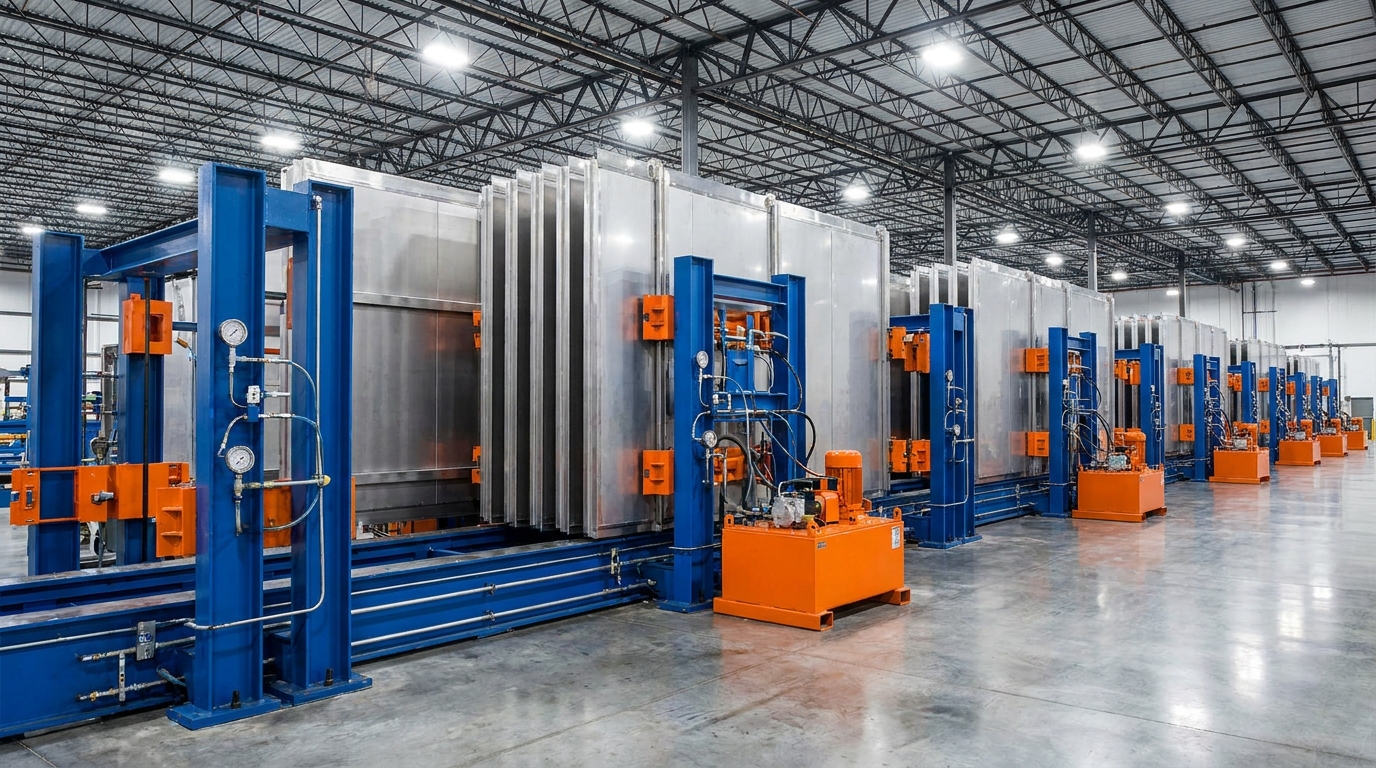
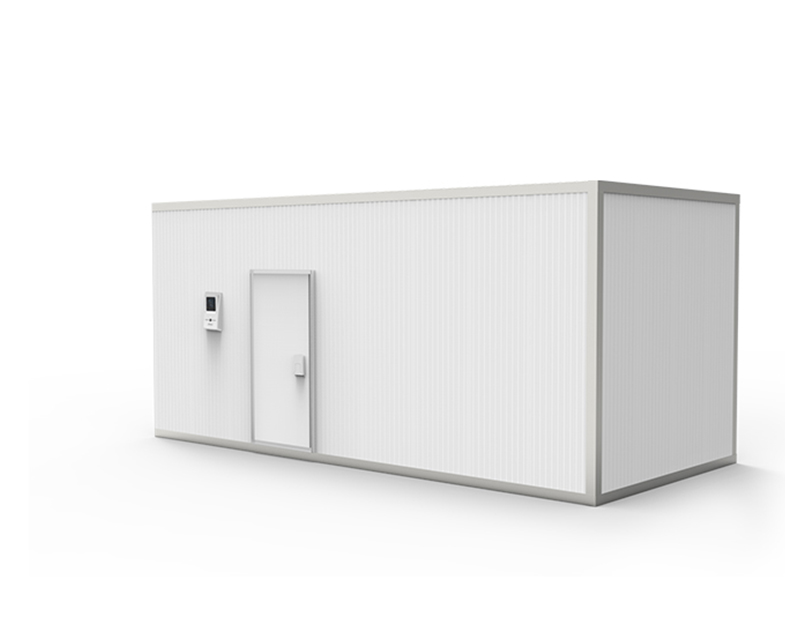
We integrates moulds, PU foaming machines and complete production lines — including cold-room panel lines — from a network of five mould factories and three machine shops, which lets us build the safety requirements of the destination market into the unit rather than bolt them on afterwards. If you are sourcing cold-room or walk-in freezer capacity for a regulated export market, start with our cold-storage room solution — then talk to us about the specification before the order is locked.
Building a factory? See our production line guide → For a complete plant, browse our cold storage room manufacturing solutions.
Frequently asked questions
What are the walk-in freezer safety requirements?
At minimum: a door that opens from the inside without a key or tool, an interior light and audible alarm, lockout-tagout points on the refrigeration plant for maintenance, a refrigerant charge that respects the destination market's limits (OSHA process safety management above 10,000 lb of ammonia in the US, EN 378 charge-limit tables in the EU), fire-rated panel cores, and documented cold-stress controls for anyone working inside. Buyers sourcing for export should confirm all six against the destination market before ordering.
Is there an OSHA temperature requirement for walk-in freezers?
No. OSHA sets no minimum or maximum temperature for a walk-in freezer and publishes no numeric cold-stress limit. Cold exposure is regulated through Section 5(a)(1), the General Duty Clause, which requires employers to control recognised hazards — in practice by following NIOSH cold-stress guidance on exposure time, warm-up breaks and cold-rated PPE.
Does OSHA require an alarm inside a walk-in freezer?
There is no OSHA clause that names a freezer alarm. What OSHA requires is that the exit be openable from the inside without a key or tool (29 CFR 1910.36) and that recognised hazards be controlled under 5(a)(1). Together those make an interior alarm or panic button standard practice, and many state and local codes require one outright.
Does OSHA require lockout-tagout on freezer compressors?
Yes. 29 CFR 1910.147 applies whenever a technician services or cleans equipment where unexpected energisation or stored energy could cause injury — which covers compressors, condensers, evaporator fans and powered doors. You need a written energy-control procedure, a lock point on each machine, and trained authorised employees.
Does OSHA require a walk-in freezer door to open from the inside?
Yes, in effect. OSHA has no single "walk-in freezer" rule, but its means-of-egress requirements (29 CFR 1910.36–.37) and the General Duty Clause oblige employers to ensure a person can always get out. In practice every walk-in freezer must have a door that opens from the inside without a key or tool, and most jurisdictions also require an interior light and an audible alarm or panic button.
What is EN 378 and how is it different from OSHA?
EN 378 is the European standard for "Refrigerating systems and heat pumps: safety and environmental requirements." It governs the refrigerating machine — refrigerant charge limits, machinery rooms, ventilation and gas detection — and supports CE conformity. OSHA, by contrast, regulates the US workplace and the workers. They cover different ground, so an export unit usually has to satisfy both. The international equivalent of EN 378 is ISO 5149.
When does a freezer refrigerant system need gas detection and a machinery room?
Under EN 378 it depends on the refrigerant's safety class, the room's occupancy category and its volume. Once the refrigerant charge exceeds the permitted limit for that combination, the system must move to a machinery room with mechanical ventilation and a refrigerant detector wired to alarms. In the US, an ammonia charge above 10,000 lb (4,536 kg) triggers OSHA process safety management and EPA risk-management requirements, which include detection and emergency response.
Is ammonia allowed in walk-in freezers?
Yes, and it is common in large industrial freezers because it is energy-efficient and has no ozone or global-warming impact. But ammonia (R717) is in the highest-demand safety tier on both continents: OSHA PSM and EPA RMP in the US, and EN 378-3 machinery-room and gas-detection rules in the EU. Most operators design to IIAR standards. For smaller or mixed-occupancy units, lower-toxicity refrigerants are often the simpler compliance path.
What should a buyer check before ordering a walk-in freezer for export?
Confirm the interior release hardware on a sample door; confirm the refrigerant choice matches the destination market's charge-limit and occupancy rules; confirm panel cores meet the required fire class with certificates; and confirm the supplier provides documentation for the destination regime — PSM/LOTO material for the US, or a technical file and marking for the EU. A supplier who can show all four is building safety in, not bolting it on.
Is there a law limiting how long someone can work in a freezer?
No numeric limit exists under US federal law. OSHA enforces cold-stress protection through the General Duty Clause (Section 5(a)(1)) rather than a fixed hours or minutes threshold, and employers are expected to follow NIOSH's cold-stress guidance — scheduled warm-up breaks, layered PPE, and exposure limits scaled to temperature and wind chill — to meet that duty. Some state-plan OSHA jurisdictions and non-US regulators publish their own cold-exposure rules, so multi-site operators should confirm local requirements rather than assume the federal baseline is the ceiling.
What makes a freezer regulatory compliant?
A regulatory compliant freezer satisfies two separate regimes at once rather than one. In the US that means OSHA coverage — an interior release on every door, lockout-tagout points on the refrigeration plant, ammonia process safety management above 10,000 lb, and documented cold-stress controls. For export to the EU it also means EN 378 (or ISO 5149) coverage — a refrigerant charge that respects the room's safety class and occupancy limits, with machinery-room ventilation and gas detection once those limits are exceeded — plus panel cores certified to the required fire class. A unit built for only one regime is not regulatory compliant for a global buyer; a unit built for both is.
Produtos mencionados neste artigo
Pronto para planear o seu projeto de refrigeração?
Partilhe o seu objetivo de produção e mix de produtos — a nossa equipa responde com plano de capacidade e cotação em três dias úteis.
Pedir cotação de engenhariaArtigos relacionados
Cold Room Panel Manufacturers in the UAE: Why "Civil Defence Approved" Is Not One Question
In the UAE, a panel's paperwork has to satisfy a federal code, a product certification scheme, and an emirate-level listing — and Abu Dhabi has just formalised 54 local amendments of its own. A brochure line reading "Civil Defence approved" answers none of those three. Here is what to ask instead, why a European supplier's fire pack is the wrong currency here, and what a 45°C ambient does to the thickness you thought you needed.
Converting a Refrigerator Foaming Line to Cyclopentane: Retrofit vs New Machine, Cost and Timeline
Switching from HFC-245fa to cyclopentane is an equipment and safety-infrastructure project, not a raw-material swap. Here's how to decide between retrofitting an existing foaming machine and buying a new cyclopentane-ready one, what the safety infrastructure actually costs, and a realistic project timeline.
Freezer Mould Selection Guide: Chest vs Upright vs Display Cabinet
A freezer mould is not one product — chest (horizontal), upright and display (island / glass-door) freezers each need a different mould geometry, clamping load and cure schedule. This guide picks the right freezer mould family by cabinet size, volume and operating temperature.