
Fridge Foam Insulation: Density & K-Factor Guide
Fridge foam insulation (rigid PU) specified for OEM cabinets: density by cabinet type, k-factor targets, wall thickness, and where vacuum panels fit.

Modern cold-chain PU foam ranges 30–50 kg/m³ density with k-factor 0.018–0.024 W/m·K. Blowing agent (cyclopentane / HFC-245fa / HFO), cell structure and ageing drive k-factor. Choosing +10% density to cut wall thickness 15% often wins more internal volume than chasing blowing-agent chemistry.
Need foam that hits a specific density and k-factor band? Skip straight to our pre-formulated PU raw material systems or high-pressure PU foaming machines built to dispense them to ±2 kg/m³ tolerance — otherwise, here's the engineering behind the numbers.
What fridge foam insulation actually is
Fridge foam insulation — also called refrigerator foam insulation — is the layer of rigid polyurethane (PU) foam injected between a fridge's outer shell and its inner liner. It is dispensed as a liquid two-component system, expands inside the closed cabinet, and cures into a closed-cell structure that both insulates the cabinet and stiffens it structurally.
Two numbers describe that layer, and they are the two this guide is about:
- Density (kg/m³) — how much polymer sits in each cubic metre of foam. Cold-chain cabinets run 30–50 kg/m³ depending on application.
- K-factor (W/m·K, also written as mW/m·K) — how much heat passes through the foam. Modern cold-chain PU sits at 0.018–0.024 W/m·K, i.e. 18–24 mW/m·K. Lower is better.
Everything else — blowing agent, cell size, ageing, wall thickness — is a lever on one of those two numbers.
Why density and k-factor matter more than price per kilo
When procurement teams compare polyurethane foam suppliers, they often focus on price per kilo of material. This misses the real cost driver of cold chain insulation: how much insulation you need in a wall to meet a given thermal performance target. Two foams with identical density can have 15% different thermal conductivity, which translates to thicker walls, smaller internal volumes, and higher energy costs for the next 15 years of the refrigerator's life.
This article explains the two physical parameters that dominate the decision — foam density and k-factor (thermal conductivity) — and how to select a formulation for refrigerator panels, cold room panels, insulation boxes, and medical transport containers.
Foam density: what it is, what it changes
Rigid polyurethane foam density is typically measured in kg/m³. In cold chain applications, we see three bands:
- 30–35 kg/m³ — Used in some low-cost household refrigerators and non-critical insulation boxes. Generally not suitable for long-term cold storage.
- 36–42 kg/m³ — The dominant range for modern household and commercial refrigerators. Good balance of mechanical strength, thermal performance and cost.
- 42–50 kg/m³ — Used in structural-insulated cold room panels and long-life commercial freezers where panel load-bearing is a requirement.
Density affects mechanical compressive strength roughly proportionally: a 42 kg/m³ foam has approximately 1.4× the compressive strength of a 32 kg/m³ foam at equal cell structure. For cold room sandwich panels that span 4–6 metres without intermediate supports, density below 40 kg/m³ is rarely acceptable. If you are evaluating the business case for a dedicated panel line, see our cold storage panel production line setup guide.
K-factor: the true insulation metric
K-factor (thermal conductivity coefficient, expressed in W/m·K) measures how much heat flows through a material per unit thickness. The lower the better. Modern rigid PU foam for cold chain reaches k-factors in the range of 0.018–0.024 W/m·K, with formulation chemistry being the dominant factor.
The three biggest levers on k-factor:
- Blowing agent choice: Cyclopentane gives k-factor around 0.021–0.023, HFC-245fa around 0.020–0.022, and newer HFO blowing agents can reach 0.018–0.020. HFO systems are more expensive but meet 2026 F-gas regulations in Europe without penalty. The guide linked above covers cost, safety infrastructure and regulatory outlook in full.
- Cell structure: Finer closed-cell structure (>95% closed cells) reduces gas diffusion and keeps k-factor stable over years. This is where formulation quality matters most.
- Ageing: K-factor drifts upward over 5–10 years as the blowing agent slowly diffuses out of the cells. A 0.020 W/m·K foam may be 0.023 after a decade. Premium formulations resist ageing better.
The density × k-factor matrix
Most buyers treat density and k-factor as independent knobs. In practice they trade off against each other:
| Application | Typical Density | Typical K-factor | Wall Thickness |
|---|---|---|---|
| Household refrigerator 4 °C | 36–38 kg/m³ | 0.020–0.022 | 40–55 mm |
| Household freezer −18 °C | 38–40 kg/m³ | 0.019–0.021 | 55–70 mm |
| Commercial freezer −25 °C | 40–42 kg/m³ | 0.019–0.021 | 70–90 mm |
| Cold room 0 °C | 40–42 kg/m³ | 0.020–0.022 | 75–100 mm |
| Deep-freeze cold room −25 °C | 42–45 kg/m³ | 0.019–0.021 | 150–200 mm |
| Insulated transport box | 36–40 kg/m³ | 0.020–0.023 | 30–60 mm |
For a factory quoting new capacity (see our production line setup and capacity investment guide), the most impactful decision is often not "do we go with cyclopentane or HFO" but rather "do we increase density by 10% to tighten k-factor and cut wall thickness by 15%". Thinner walls mean higher internal volume at the same external footprint, which is a direct selling point to end customers.
Which refrigerator insulation foam should you specify?
For a foamed-in-place cabinet there is really one answer: rigid closed-cell polyurethane, injected as a two-component system and blown with cyclopentane, HFC-245fa or an HFO. Board stock (XPS, EPS, PE foam) and DIY spray foam show up in repair and retrofit searches, but no OEM line uses them for the cabinet core — they cannot be injected, do not bond the shell to the liner, and do not give the cabinet its stiffness.
The one genuine alternative is the vacuum insulation panel (VIP): a porous core sealed under vacuum in a barrier film, with a thermal conductivity a fraction of rigid PU's. Premium household models chasing the top energy label glue VIPs to the liner and then foam PU around them. Two things to settle before specifying VIPs: they are an insert inside the PU layer, not a replacement for it (the PU still fills, bonds and stiffens the cabinet), and a punctured VIP loses most of its benefit, so handling and jig design matter. For most commercial and mid-range household cabinets, the density and k-factor levers in this guide buy more per dollar than VIPs; where regulation pushes the label class, see the 2026 DOE / EU ecodesign rules. Covestro's note on PU-cored VIPs for refrigerators is a good primer on the hybrid approach.
Where the foam sits in the cabinet wall
A typical refrigerator wall is three layers: a pre-painted steel or plastic outer shell, the injected PU core, and a thermoformed ABS or HIPS inner liner. The cabinet is clamped in a foaming jig so expansion pressure cannot deform the liner, and stays clamped until the foam is dimensionally stable enough to demould.
This is why foam specification and tooling specification are not separate decisions:
- The liner sets the internal geometry the foam has to fill without voids — see our guide to ABS/HIPS liner thermoforming.
- The foaming jig holds the cabinet against expansion pressure; jig rigidity and clamping consistency drive wall thickness consistency.
- The dispensing machine sets shot accuracy and mixing quality — the step that turns a good formulation into a good foam. See high-pressure vs low-pressure foaming.
A foam system that performs in a lab cup test can still give voids, density gradients and cold spots if the jig and the shot are wrong.
Testing and incoming inspection
A responsible incoming-material inspection for PU raw material systems should include:
- Free-rise density test — foam a small sample in a cup, weigh it. Should match the supplier's TDS within ±5%.
- Cream time, gel time, tack-free time — timing reactivity at specified temperature. Drift indicates isocyanate index error or polyol age.
- K-factor test — uses a guarded hot plate or heat flow meter. Lab test required; on-site not feasible.
- Closed-cell content — ASTM D6226 gas pycnometry. >95% is the target for cold chain-grade foam.
- Compressive strength at 10% deformation — ASTM D1621. 180–220 kPa typical for 40 kg/m³ foam.
Four common mistakes in foam formulation selection
- Mixing blowing agents without re-tuning the catalyst package. Swapping HFC-245fa for HFO without adjusting catalysts typically results in poor cell structure and 8–12% k-factor penalty.
- Ignoring ambient humidity. Polyol is hygroscopic. Storage above 65% RH causes moisture pickup, which reacts with isocyanate to produce CO₂ (good for foaming, bad for k-factor).
- Over-rotating between suppliers. Each formulation needs a process window. Alternating between three suppliers every six months wipes out the process learning that produces consistent results.
- Testing only at ambient temperature. Cold chain foam should be tested at 10 °C and 20 °C mean temperature, because k-factor varies with temperature.
How to specify a PU system to a supplier
A good specification contains at minimum:
- Target density (with tolerance, typically ± 2 kg/m³)
- Target k-factor at 10 °C mean temperature (with ageing profile if known)
- Reactivity profile (cream/gel/tack-free at 20 °C)
- Blowing agent (cyclopentane / HFC-245fa / HFO-1233zd / HFO-1336mzz)
- Compliance requirements (REACH, RoHS, F-gas regulation, ozone depletion potential)
- Mould temperature and demould time target
- Annual volume and shelf-life handling plan
Once specified, the formulation should be locked with a sample-approval process and re-tested every batch for the first three batches. Our high-pressure PU foaming machines are designed to dispense against any of the above blowing agents with stable metering accuracy, so the foam formulation does not have to change when you upgrade your equipment. Not sure whether high-pressure or low-pressure is right for your line? Read our high-pressure vs low-pressure comparison.
Building a factory? See our production line guide → For a complete plant, browse our refrigerator manufacturing solutions.
What is fridge foam insulation?
Fridge foam insulation is rigid closed-cell polyurethane (PU) foam injected between a fridge's outer shell and inner liner, at 30–50 kg/m³ density and 0.018–0.024 W/m·K (18–24 mW/m·K) k-factor depending on cabinet type. It is the same material referred to as refrigerator foam insulation — "fridge" and "refrigerator" describe the identical PU layer.
What PU foam density is recommended for household refrigerators?
Standard household refrigerators use rigid PU foam at 36–38 kg/m³ density, which gives a k-factor around 0.020–0.022 W/m·K (20–22 mW/m·K) with adequate mechanical strength. Household freezers and premium models chasing the top energy label move up to 38–40 kg/m³ for better long-term insulation retention.
What does k-factor mean in PU foam insulation?
K-factor (thermal conductivity, in W/m·K or mW/m·K) indicates how well foam blocks heat transfer; lower is better. For refrigerator PU foam, initial k-factor is 0.018–0.024 W/m·K (18–24 mW/m·K) depending on blowing agent and cell structure. It drifts upward over 5–10 years as blowing agent diffuses out of the cells — a 0.020 W/m·K foam is typically around 0.023 after a decade.
How does foam density affect cold chain equipment performance?
Higher density foam has more polymer per unit volume, which means better compressive strength and slower ageing — but higher raw material cost. Using the matrix above: household refrigerators sit at 36–38 kg/m³, commercial freezers at −25 °C at 40–42 kg/m³, and deep-freeze cold room panels at 42–45 kg/m³. Over-specifying density wastes material; under-specifying shortens product lifespan.
Can PU foam density be tested on the production line?
Yes. Core density is measured by cutting a 100×100×50 mm sample from the center of a foamed panel or cabinet wall, weighing it, and dividing by volume. Production lines should test at least 3 samples per shift. Target tolerance is ± 2 kg/m³ from the specified density. Automated ultrasonic density gauges can measure in-line without cutting.
What is the relationship between PU foam cell size and insulation quality?
Smaller, more uniform closed cells trap blowing agent gas more effectively, reducing radiative and convective heat transfer. High-pressure foaming produces cell diameters of 150–250 μm with over 95% closed-cell content. Low-pressure foaming produces larger cells (250–400 μm) with 85–90% closed-cell content, resulting in 10–15% higher k-factor (worse insulation) at the same density.
What foam is used for refrigerator insulation?
Refrigerator insulation foam is rigid closed-cell polyurethane injected between the outer shell and the inner liner, at 30–50 kg/m³ density and 0.018–0.024 W/m·K (18–24 mW/m·K) k-factor depending on the cabinet type. Premium energy-label models add vacuum insulation panels inside the PU layer; board stock and DIY spray foams are repair materials, not OEM cabinet insulation.
Products Mentioned in This Article
Ready to plan your refrigeration project?
Share your target output and product mix — our engineering team replies with a capacity plan and quote within three business days.
Get an engineering quoteRelated articles
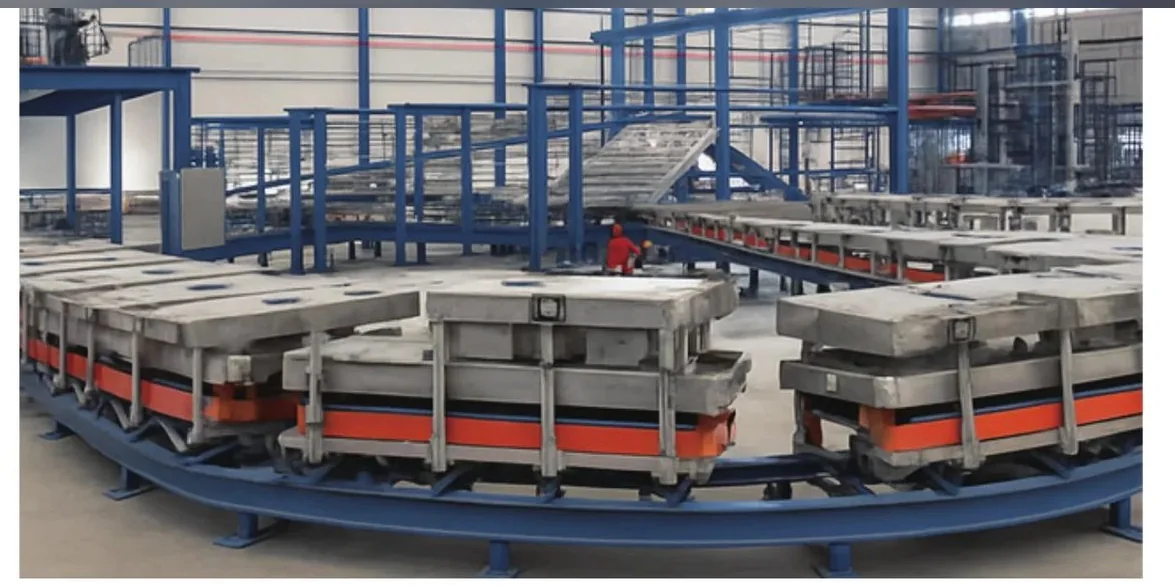
26-Station Ground-Rail Foaming Line Throughput: The Real Math Behind the Numbers
The station count in a foaming line's name is the wrong number to size capacity on. Hourly output is set by takt time and OEE; the 26 stations set curing time and work-in-process. This guide walks the actual throughput math for a closed-loop ground-rail line so you size it against your real production target.
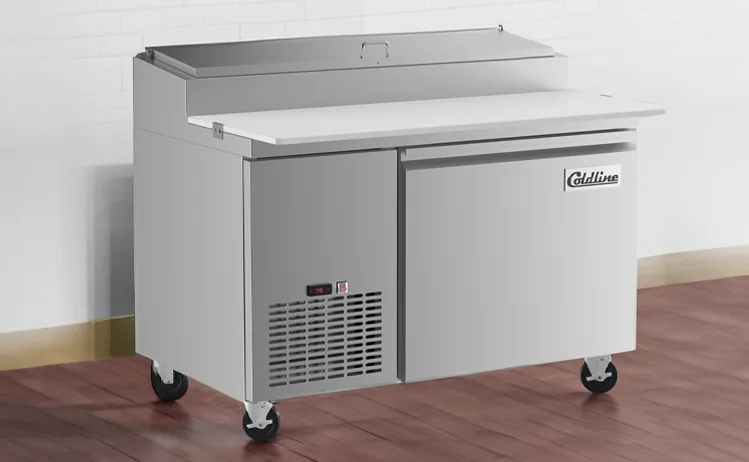
Chef Base PU Foaming, Deep Dive: Why a Load-Bearing Cabinet Is Foamed Differently from a Domestic Fridge
A chef base carries heavy cooking equipment on its top deck, soaks up radiant heat from the cooktop, and is built from two stainless skins — so its PU foam has to be a structural member and an insulator at once. This deep dive walks the engineering that separates chef-base foaming from domestic-cabinet foaming: load-bearing density, k-factor under a hot deck, stainless adhesion, and the defect modes that punish treating the two cabinets the same.

Cigar Humidor Cabinet PU Foam, Deep Dive: Why a Humidity-Holding Cabinet Is Foamed Differently from a Cold-Chain Fridge
A cigar humidor cabinet shares a fridge's two-skin, one-PU-shot construction but not its goal: it holds a narrow 65–72% relative-humidity band at around 18 °C, not a low temperature. This deep dive walks the engineering that makes humidor foaming its own discipline — RH stability, a vapor-tight envelope (ASTM E96 permeance), the condensation a single void causes near saturation, dimensional stability so the door seal stays tight for years, and why it is a precision low-pressure job rather than a high-volume one.